If you’ve built a budget that works, the next logical step is making your money grow. If you haven’t built that foundation yet, start with our guide on 15 Budgeting Tips That Actually Work in 2026 — it takes 30 days and makes everything below easier.
But if the investing world feels like a casino where the house always wins, you’re not alone. Two in five people say they avoid investing because they don’t understand it. Here’s what they don’t know: in 2026, the barriers that kept regular people out are gone. You can start investing with as little as $10, and you can do it from your phone in about 15 minutes. This guide on how to start investing for beginners shows you exactly how..
Key Takeaways:
- You can start with $10 or less — the biggest myth about how to start investing for beginners is that you need a lot of money.
- Start with a tax-advantaged account like a Roth IRA before a regular brokerage account
- Buy a low-cost index fund — don’t try to pick individual stocks as a beginner
- Automate your contributions. The habit matters more than the amount
- 2026 offers new AI tools that make research and portfolio building easier than ever
Why Most Beginners Never Actually Start
The biggest lie about how to start investing for beginners is that you need to know something special first.
The most common reason people give for not investing is “I don’t have enough money.” In 2026, that reason no longer holds.
Fractional shares — which let you buy a slice of a $500 stock for $10 — are now standard at most major brokerages. Commission-free apps mean you don’t pay fees to buy or sell. And index funds let you own hundreds of companies at once, so you never have to pick a “winner.”
The real barrier is psychological. People wait until they have “enough” money. That day never comes. The habit of investing — even $25 a month — is what builds wealth.
The $10 Experiment (Do This Today)
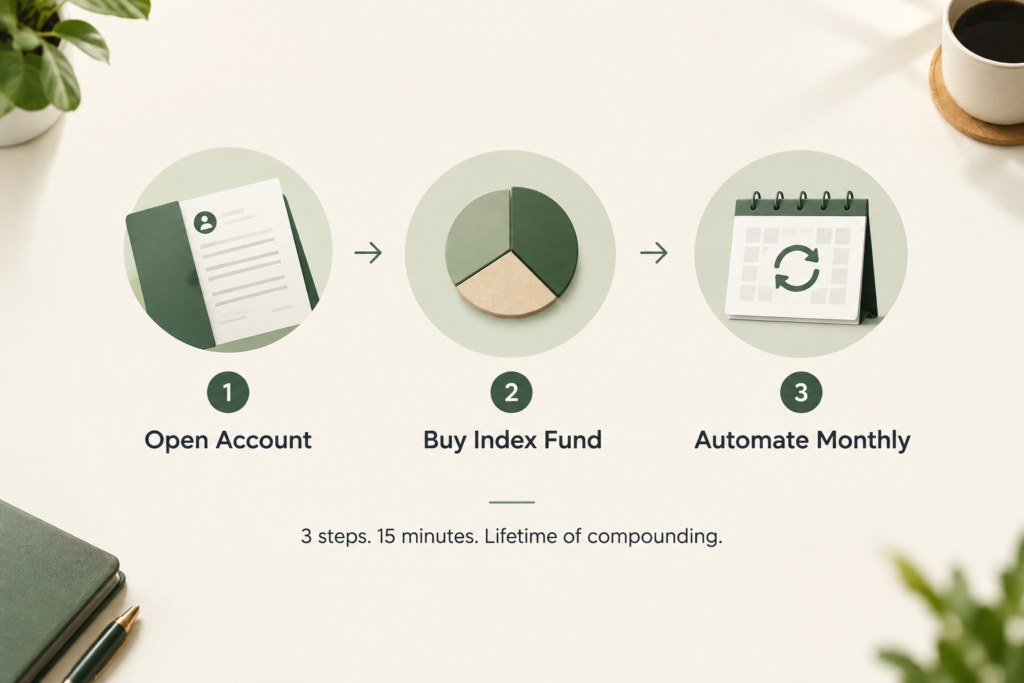
Here’s a simple test. Open a brokerage account (Fidelity, Vanguard, Schwab, or Robinhood all have zero minimums and zero commissions). Transfer $10. Buy a fractional share of an S&P 500 index fund. That’s it.
You just became an investor. The psychological shift from “I can’t” to “I did” is worth more than the $10 itself.
Step 1 — Open the Right Account (Order Matters)
Where you invest matters as much as what you buy when you’re learning how to start investing for beginners, because the account type determines your taxes.. Here’s the order most experts recommend:
- 401(k) with Employer Match
If your job offers a 401(k) with matching contributions, contribute at least enough to get the full match. This is free money — an instant 50-100% return on every dollar you put in. - Roth IRA
A Roth IRA lets your money grow tax-free. You contribute after-tax dollars, and when you withdraw in retirement, you pay no taxes on the growth. In 2026, you can contribute up to $7,500 per year. For beginners — especially those in lower tax brackets now — this is the best retirement account available. - Regular Brokerage Account
Once you’ve maxed out the tax-advantaged accounts, or if you’re investing for a goal before retirement (like a house down payment), open a regular taxable brokerage account. No contribution limits, no early-withdrawal penalties.
What About Fees?
Fees are the silent killer of investment returns. A 1% annual fee doesn’t sound like much, but over 30 years it can eat 25% of your gains.
When choosing an account, look for:
- Zero commission on stock and ETF trades
- Zero account minimum (so you can start with any amount)
- Low expense ratios on the funds you buy (index funds should be under 0.10%)
Step 2 — Choose What to Buy (Keep It Simple)
Beginners often freeze at this step of how to start investing for beginners.. They think they need to research individual companies, read earnings reports, and predict the next Amazon.
You don’t. In fact, doing that usually leads to worse results than doing almost nothing.
The Boring Answer That Beats 90% of Professionals
The best answer for how to start investing for beginners is also the most boring one: buy a low-cost S&P 500 index fund.
An S&P 500 index fund holds shares in the 500 largest U.S. companies — Apple, Microsoft, Nvidia, Amazon, and 496 others. When you buy it, you own a tiny slice of all of them. You never have to pick a winner because you own the entire market.
Why this works: Over the past 50 years, roughly 90% of professional fund managers have failed to beat the S&P 500. If the experts can’t do it, you probably can’t either. But you can match their returns by buying the index at nearly zero cost.
The Three Funds That Cover Everything
| Fund | What It Covers | Why Beginners Like It |
| VOO or VTI | U.S. stock market (500 or 3,600+ companies) | The core of your portfolio. Low cost (0.03%) |
| VXUS | International stocks (companies outside the U.S.) | The U.S. is only ~60% of global markets |
| BND | U.S. bonds | Reduces volatility. Add 10-20% for stability |
If you want a simple, diversified portfolio, here are the three funds most experts recommend for beginners:
Step 3 — Automate It (This Is the Most Important Step)
The single best thing you can do as a beginner investor is set up an automatic transfer.
Here’s why automation matters more than the amount: A study of the S&P 500 over 40 years showed that investing $250 per month — with no market timing, no stock picking — would have grown to $1.8 million. The total contributions were only $120,000. The rest was compounding and time.
But the only way to get that result is to stay invested through every market crash, every scary headline. Automation removes the emotional decision-making that causes people to sell at the bottom.
How to Set It Up
In your brokerage app, find the “automatic investment” feature
- Set a fixed amount — $25, $50, $100, whatever you can sustain
- Choose the same day each month
- Select your index fund
That’s it. You’re now investing on autopilot.
Step 4 — The 2026 Upgrade: Where AI and Fintech Fit In
Here’s where this guide differs from the typical “buy index funds and wait 30 years” advice.
In 2026, a new category of AI-powered tools has emerged that makes investing research faster and more accessible for beginners.
AI Investing Tools for Beginners
Platforms like Danelfin assign AI scores to thousands of stocks based on probability of outperforming the market. TrendSpider offers automated technical analysis without requiring coding. Perplexity Finance combines multiple AI models to generate investment analysis with sources cited.
But here’s the catch: These tools are best used as learning aids and screeners, not as oracles. A general AI chatbot can explain what a P/E ratio is, but it cannot predict whether a stock will go up. Use AI to understand concepts faster, not to make decisions for you.
High-Yield Savings and Stablecoin Yield
Your emergency fund — the money you keep for unexpected expenses — shouldn’t sit in a checking account earning 0.01%. In 2026, you have options:
- High-yield savings accounts typically earn 4-5% APY
- Stablecoin yield through platforms like Pulsar.money offers ~5.2% APY on USD and EUR holdings
These aren’t investments in the stock market sense. They’re places to park cash you need to be safe and accessible. But earning 5% instead of 0.01% on $5,000 is $250 per year — real money for doing nothing.
Virtual Cards and Global Spending
One more 2026 upgrade: virtual cards that work for international subscriptions and purchases. If you’ve ever had your card declined for Netflix or Spotify because it’s a “local” card, a USD virtual card solves that problem. These aren’t investing products. But they’re part of the modern financial toolkit that makes your money more usable.
My Personal Opinion on Beginner Investing in 2026
Here is what I, as the writer, actually think about the current state of investing for beginners.
I think the financial industry has spent decades making investing seem harder than it is. The message has always been: “You need to be smart, you need to pick the right stocks, you need to time the market.” That message benefits the industry — it keeps people paying for advisors and expensive funds. It doesn’t benefit you.
The truth is simpler and more powerful: Buy a low-cost index fund. Automate it. Don’t touch it for 30 years. You will beat most professionals.
I see too many beginners in 2026 getting distracted by the wrong things. They watch videos about “the next 100x crypto” and ignore the boring index fund that would actually build their wealth. They chase yield in risky places when a 5% stablecoin account would serve them better.
My advice: Do the boring thing first. Max out your Roth IRA. Buy VOO. Automate $50 a month. Then, once that foundation is set, you can explore the newer AI tools and fintech options. But never let the shiny new thing distract you from the core habits that have built wealth for a century. Index funds aren’t exciting. But they work.
Common Beginner Investing Mistakes to Avoid
- Waiting for the “right time” to invest. Time in the market beats timing the market
- Picking individual stocks because you “have a feeling.” You don’t have an edge. Buy the index
- Checking your portfolio every day. The market goes up and down. Daily checks cause panic selling
- Chasing yield in risky places. If an investment promises 20% guaranteed, it’s a scam
- Ignoring fees. A 1% fee doesn’t sound like much, but it compounds against you
- Investing money you need soon. Only invest money you won’t touch for at least 5 years
Beginner Investing FAQ
How much money do I need to start investing?
You can start with $10 or even $5 in 2026. Fractional shares let you buy a slice of any stock or fund. The amount matters far less than the habit.
What’s the best investment for a beginner?
A low-cost S&P 500 index fund. It gives you instant diversification across 500 companies, charges almost nothing in fees, and has historically returned about 10% per year on average.
Should I pay off debt before investing?
If you have high-interest debt (like credit cards at 20%+ APR), pay that off first. No investment reliably returns 20%. But if you have low-interest debt (like a mortgage at 4%), you can invest while paying it down. We cover this in detail in our upcoming [Debt Management guide].
What if the market crashes right after I invest?
It will, at some point. That’s normal. Since 1945, the S&P 500 has experienced 20%+ drops many times — and recovered from every one. If you’re investing for 10+ years, a crash is a buying opportunity, not a disaster.
How do I start investing for beginners with little money?
Open a zero-minimum brokerage account. Set up a recurring transfer of $10-25 per month. Buy a fractional share of an index fund. Automate it. That’s the entire process.
The Bottom Line
Learning how to start Knowing how to start investing for beginners doesn’t have to be complicated… In 2026, the tools exist to start with almost any amount, from any phone, with almost no fees. The only thing standing between you and your first investment is the decision to start.
Open the account. Transfer the money. Buy the index fund. Set the automation. Then go back to living your life. That’s how wealth gets built — slowly, boringly, and almost automatically.
If you’re still building your foundation, start with our 15 Budgeting Tips That Actually Work in 2026 before investing. A budget is what keeps your investing consistent.