
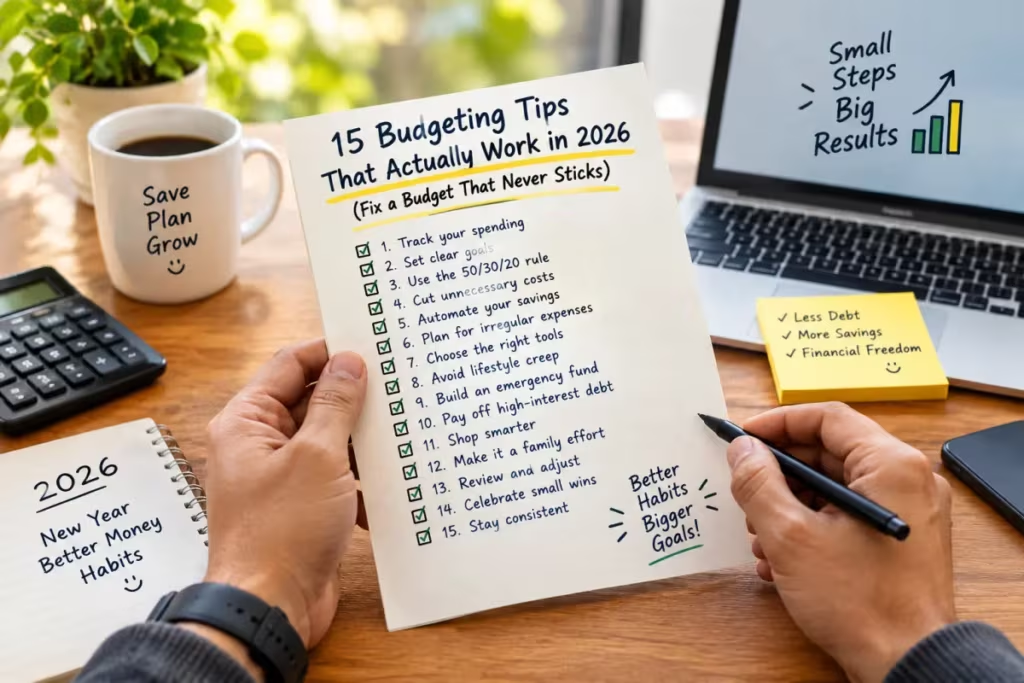
Quick answer: These 15 budgeting tips show you how to track your spending, build a realistic monthly budget around your paydays, plan for irregular bills, reduce unnecessary costs, and grow your savings without relying on guesswork. Each tip includes a practical action and a worked example you can adapt to your own income and expenses. For households, see our practical budgeting tips for managing monthly expenses.
Most budgets don’t fail because people can’t add. They fail because the plan was built from guesses: a grocery number copied from a blog, no line for the car registration that arrives every spring, and savings that depend on whatever is left at the end of the month. This guide fixes that with steps you can set up in an afternoon and check in 10 minutes a week.
All dollar examples are hypothetical and rounded, so swap in your own numbers. National figures are linked to the U.S. government source they come from.
Start here if you have just 15 minutes: (1) write down your take-home pay and each payday, (2) review your last three months of bank and credit card statements, and (3) schedule a small automatic savings transfer for the day after payday. Then use Tips 1, 2, and 8 to build the rest of your budget.
Key Takeaways
- Budget your take-home pay on the dates it actually arrives, not your salary.
- Use three months of real statements to set limits. One month can mislead you.
- Give non-monthly bills a monthly line (sinking funds) so they stop feeling like emergencies.
- Automate savings the day after payday, then spend what’s left.
- Put extra money toward high-APR debt first. The average rate on credit card accounts charged interest was 22.36% in August 2026, according to the Federal Reserve.
- Review weekly and reset monthly. A budget you adjust usually lasts longer than a strict one you abandon.
Which Budgeting Method Should You Use?
Choosing the right budgeting method makes it easier to manage your money consistently. Your ideal approach depends on how regularly you earn, how much detail you want to track, and where you tend to overspend. The 50/30/20 rule offers simple spending guidelines, zero-based budgeting assigns every dollar a purpose, and envelope budgeting helps control flexible expenses. Treat these methods as starting points rather than strict rules, especially if essential expenses already take up more than half your income.
| Method | How it works | Weekly time | Best fit |
|---|---|---|---|
| 50/30/20 | About 50% of take-home pay to needs, 30% to wants, 20% to savings and extra debt payments | About 5 minutes | Steady paychecks; you want simple guardrails |
| Zero-based | Income minus every planned dollar (bills, savings, spending) equals $0 | 15–20 minutes | Tight margins, irregular income, detail-oriented planners |
| Pay yourself first | Automate a fixed savings and debt amount on payday, then spend the rest freely | About 2 minutes | Busy people who won’t track small purchases |
| Envelopes and sinking funds | Load set amounts into separate sub-accounts or cash envelopes for flexible and annual costs | About 10 minutes | Overspending on groceries, dining out or holidays |
Want the step-by-step version of the most detailed method? Our zero-based budgeting guide walks through examples at several income levels.
Stage 1: Track Your Spending and Paydays
You can’t set realistic limits until you know three things: how much arrives, when it arrives and where it went last month.
1. Budget Around Your Actual Paycheck Dates
Why it matters: Rent is due on the 1st whether your paycheck lands on the 1st or the 9th. A monthly total can look fine on paper while one pay period comes up short.
What to do: Write each paycheck’s net amount and deposit date on a calendar. Then place every fixed bill under the paycheck that will cover it.
Example: A $2,077 biweekly net paycheck works out to about $4,500 a month ($2,077 × 26 ÷ 12). But you get 26 paychecks a year, not 24. Budget on two paychecks a month, and decide in advance where the two “extra” paychecks go, such as an emergency fund or a debt payoff.
Do it today: If a big bill lands before payday, ask the company whether you can move its due date. Some lenders and utilities allow it.
2. Average Three Months of Spending Before Setting Limits
Why it matters: One month can include a birthday, a car repair or a light grocery week. An average gives you a baseline you can keep to.
What to do: Export at least three months of checking account and credit card transactions. Group purchases into categories such as housing, groceries, transportation, utilities, subscriptions, and entertainment. Add the spending in each category and divide it by three to calculate your average monthly expense. Use these actual figures to establish realistic spending limits instead of choosing amounts based on assumptions. Our budget categories list can help you set realistic monthly spending limits for each line.
Example: Groceries were $640, $710 and $760. The average is $703, so a $500 grocery limit would probably fail by week three. Start near $700 and lower it gradually (see tip 5). Planning low-cost meals can help you set a weekly grocery budget you can keep.
Keep grocery purchases and restaurant or takeout spending in separate categories so you can see whether food costs are rising at home or away from home. Then rank your categories by monthly total and look first for one or two large flexible expenses you can realistically reduce; a modest cut to a major category can save more than eliminating several small purchases.
3. Label Every Expense as Fixed, Flexible or Non-Monthly
Why it matters: Each type needs a different tactic. You renegotiate fixed bills once, manage flexible spending weekly and save for non-monthly costs ahead of time.
What to do: Tag each line from tip 2:
- Fixed: rent or mortgage, insurance, loan minimums, phone and internet.
- Flexible: groceries, gas, dining out, shopping, entertainment.
- Non-monthly: car registration, annual memberships, holidays, school costs, medical copays.
Example: If $1,900 of a $4,500 month is fixed, focus weekly attention on the flexible lines and do one review call per fixed bill each year. For a ready-made category list, see our budget categories guide.
You can also calculate your minimum monthly living-cost baseline by adding essential expenses such as housing, utilities, groceries, insurance, transportation, childcare, and minimum debt payments. This gives you a practical estimate of the income required to cover essential obligations before allocating money to discretionary spending, additional savings, or extra debt repayments.
Stage 2: Build a Realistic Monthly Budget
4. Choose One Method That Matches How You’re Paid
Why it matters: Switching systems every month resets your progress. Pick one method and use it for at least 90 days.
What to do: Use this rule of thumb. With steady pay and little time, start with 50/30/20 or pay yourself first. With irregular pay or very tight margins, use zero-based budgeting.
Irregular income example: If your last 12 months ranged from $3,200 to $5,600, build the core budget on $3,200 (your lowest month). In higher months, send the extra first to a tax set-aside if you’re self-employed, then to a one-month income buffer.
Set at least one measurable financial goal alongside your budgeting method. Instead of simply deciding to save more money, establish a specific target, such as saving $1,000 for unexpected expenses within ten months. Divide the target by the number of months remaining and include that amount in your monthly budget. Make sure the goal is specific, measurable, achievable, relevant, and time-bound.
5. Give Groceries a Fixed Weekly Number
Why it matters: Food is a large flexible cost. The average U.S. household (consumer unit) spent $10,633 on food in 2025, including $4,142 on food away from home, according to the Bureau of Labor Statistics Consumer Expenditure Survey.
What to do: Turn your monthly grocery amount into a weekly limit (monthly × 12 ÷ 52), shop with a list and plan a few low-cost dinners each week. Our budget-friendly meals guide prices out six options.
Example: Cutting a $700 monthly grocery budget by 10% gives $630, or about $145 a week. That saves $70 a month and $840 a year.
Benchmark: The USDA’s October 2026 Moderate-Cost Food Plan lists $337.00 per month for a female aged 19–50 and $398.90 for a male aged 19–50, using its four-person household baseline. For a two-person household, USDA suggests adding 10% to the combined amount: ($337.00 + $398.90) × 1.10 = approximately $809.49 per month (USDA Food Plans). The plan assumes meals and snacks are prepared at home, so restaurant meals and takeout should be budgeted separately. Actual grocery costs vary by household size, location, dietary preferences, and shopping habits.
6. Set a Weekly Allowance for Flexible Spending
Why it matters: A monthly “fun” budget is easy to overspend by the 12th. A weekly limit resets often enough to correct course, and it still leaves room for things you enjoy.
What to do: Add up dining out, entertainment, hobbies and personal shopping. Convert the total into a weekly amount and keep it on one debit card or in a separate checking sub-account.
Example: $600 a month × 12 ÷ 52 is about $138 a week. If you spend $160 one week, the next week’s allowance is $116. You don’t need to cut a whole category.
If you repeatedly exceed your limit in a particular category, consider using the cash envelope method or a separate digital spending account. Set aside the amount allocated for groceries, dining, entertainment, or personal purchases at the beginning of the week. Once that allocation is used, pause additional spending in that category until the next budget period.
7. Build Sinking Funds for Non-Monthly Bills
Why it matters: Predictable but infrequent costs are a common way budgets break. In the Federal Reserve’s survey of 2025 household finances, a major vehicle repair or replacement was the most commonly reported unexpected expense, cited by 30% of adults (Federal Reserve SHED).
What to do: List each non-monthly cost, estimate the yearly total and divide by 12.
Example: Car registration $120 + car maintenance $600 + holidays and gifts $600 + annual memberships $120 + medical copays $360 = $1,800 a year. Divide by 12 to get a $150 monthly sinking-fund transfer.
Stage 3: Build Savings and Manage Debt
8. Automate Savings the Day After Payday
Why it matters: Money left in checking tends to get spent. Moving it first makes saving the default.
What to do: Schedule a recurring transfer for the day after each deposit, or ask your employer to split your direct deposit between checking and savings. You can split a federal tax refund across up to three accounts using your tax software or IRS Form 8888 (IRS).
Example: $50 per biweekly paycheck × 26 = $1,300 a year. Moving one of the two “extra” paychecks from tip 1 into savings as well adds another $2,077.
9. Build Emergency Savings in Stages, in a Separate Insured Account
Why it matters: In the Federal Reserve’s survey of 2025 household finances, 63% of adults said they would cover a $400 emergency expense using cash or its equivalent. That means 37% would not rely on cash or its equivalent alone.
What to do: Use three stages. First save a $500–$1,000 starter fund, then one month of essential expenses, then three to six months. Keep the money in a savings account separate from your debit card.
Check the insurance: The FDIC insures deposits up to at least $250,000 per depositor, per ownership category, at each FDIC-insured bank (FDIC). FDIC insurance covers deposit accounts such as checking and savings. It doesn’t cover stocks, bonds, mutual funds or crypto, even when you buy them through a bank. Credit unions are covered separately by the NCUA.
Example: At $300 a month, a $1,000 starter fund takes about four months. One month of $2,800 in essentials takes about another six months after that.
10. Put a Fixed Extra Payment on Your Highest-APR Debt
Why it matters: According to the Federal Reserve’s G.19 consumer credit release of November 6, 2026, the average interest rate on credit card accounts that were charged interest was 22.36% in August 2026, a revised figure (Federal Reserve G.19). Carrying a balance at that rate slows every other goal.
What to do: Pay all minimums, then add one fixed extra amount to the card with the highest APR. Paying the highest-APR debt first is called the debt avalanche.
The debt snowball method works differently: it directs extra payments to the smallest balance first while you continue making minimum payments on your other debts. The avalanche method generally reduces interest costs when interest rates differ, while the snowball method can provide quicker account payoffs that may help some people stay motivated.
| $3,000 balance at 22.36% APR | Monthly payment | Months to pay off | Total interest |
|---|---|---|---|
| Fixed $90 payment | $90 | 53 | About $1,731 |
| $90 + $100 extra | $190 | 19 | About $586 |
In this example, paying an additional $100 each month reduces the estimated repayment period from 53 months to 19 months and lowers total interest by approximately $1,145. The estimates use a simplified monthly calculation: monthly interest is calculated as the outstanding balance multiplied by 22.36% ÷ 12, with a fixed monthly payment and no new purchases; the final payment is adjusted to clear the remaining balance. Actual lender calculations may differ because many credit cards calculate interest daily, and fees and payment timing can also affect the total. If you pay only the required credit card minimum, your payment may decrease as the balance falls, potentially extending the repayment period. Run your own numbers in our debt payoff calculator, and compare methods in how to pay off debt. If minimum payments have become hard to manage, our guide to debt relief programs and when to consider them outlines the options and risks.
11. Review Subscriptions Quarterly and Re-Shop Fixed Bills Annually
Why it matters: Subscriptions, phone plans, internet and insurance renew automatically, so price increases often go unnoticed.
Review subscription charges every three months, and compare phone, internet, and insurance plans at least once a year or before renewal.
What to do: List every recurring charge from tip 2. For each one, decide whether to keep it, downgrade it, cancel it or shop for a better price. When you cancel, keep the confirmation. If charges continue after you cancel, contact the company and then your card issuer about disputing the charge.
For recurring services such as internet, mobile phone plans, and insurance, compare at least two equivalent offers before renewing. Contact your current provider and ask whether it can match a competitor’s price or offer a lower-cost plan. Before switching insurance, compare coverage limits and deductibles as well as premiums. Keep confirmation records when cancelling subscriptions or changing recurring payments.
| Bill | Before | Action | After | Monthly savings |
|---|---|---|---|---|
| Streaming | $18 | Switch to ad-supported tier | $8 | $10 |
| Phone plan | $85 | Move to a smaller data plan | $55 | $30 |
| Car insurance | $160 | Compare quotes at renewal | $135 | $25 |
| Total | $263 | $198 | $65 ($780 a year) |
Prices are illustrative.
Stage 4: Keep Your Budget on Track
12. Use a Waiting Rule for Unplanned Purchases Over $50
Why it matters: One-click checkout makes it easy to spend before you’ve had time to think.
What to do: Put any unplanned non-essential item over $50 on a dated wish list and wait at least 48 hours. If you still want it and it fits this week’s allowance (tip 6), buy it without guilt.
Example: If the rule stops two $60 impulse buys a month, that’s $120 a month you can redirect to tip 9 or tip 10.
13. Split Every Raise and Windfall Before You Get Used to It
Why it matters: When income rises, spending often rises with it. This is called lifestyle creep.
What to do: Decide the split before the first bigger paycheck arrives. For example, send half of any net raise to savings, debt or retirement, and keep half for your lifestyle.
Example: A raise that adds $300 a month after taxes becomes $150 to savings and $150 to spending. That’s $1,800 a year saved, and you still feel the raise. To see how a higher 401(k) or IRA contribution could grow, try our retirement calculator or read saving for retirement in your 20s.
14. Do a 10-Minute Weekly Check-In and a Monthly Reset
Why it matters: If you catch an overspend in week two, you can still fix it. If you find it on the 30th, you can only note it for next month.
What to do: Every week, check three numbers: grocery money left, flexible allowance left and any bill due before the next payday. Once a month, compare your plan with what you actually spent and adjust limits that missed twice in a row.
If you share household expenses with a partner or family member, list shared bills separately from personal spending, agree on each person’s contribution and individual spending amount, and review the plan together before the next spending period. You can also enable bill reminders, low-balance notifications, and spending alerts through your bank or budgeting application where available. These reminders help identify potential overspending and upcoming obligations before they disrupt your monthly plan.
Example: If groceries are $40 over in week two, take $20 from each of the next two weeks’ flexible allowance. You won’t need to rebuild the whole budget.
15. Track Three Progress Numbers Every Month
Why it matters: Category limits tell you about one month. Progress numbers show whether your plan is actually moving you forward.
What to do: On the same day each month, record:
- Savings rate: money saved ÷ take-home pay.
- High-interest debt balance: total owed on cards and similar debt.
- Emergency fund in months: savings ÷ monthly essential expenses.
If you also track your assets and liabilities, consider recording your net worth once a month. Subtract total liabilities from total assets to see whether your overall financial position is improving over time.
Example: Saving $550 of $4,500 is a 12.2% savings rate. The separate $100 extra debt payment brings the combined savings-and-debt allocation to $650, or 14.4% of take-home pay. Once the margin is steady, you can look at raising income too. Our passive income guide explains which options take real work.
Sample $4,500 Monthly Budget (Take-Home Pay)
This hypothetical budget is for a single renter with $4,500 in take-home pay. Needs come to 61% of income, above the 50% target, which is common in high-rent areas. The plan still funds savings, sinking funds and an extra debt payment.

| Line | Monthly | Type |
|---|---|---|
| Rent | $1,350 | Fixed need |
| Utilities | $170 | Fixed need |
| Phone and internet | $120 | Fixed need |
| Car insurance | $135 | Fixed need |
| Credit card minimum | $90 | Fixed need |
| Groceries ($145 a week) | $630 | Flexible need |
| Gas and transit | $200 | Flexible need |
| Household and personal care | $60 | Flexible need |
| Needs subtotal | $2,755 (61.2%) | |
| Weekly allowance: dining, fun, shopping ($138 a week) | $600 | Want |
| Subscriptions | $45 | Want |
| Sinking funds (tip 7) | $150 | Planned non-monthly |
| Wants and sinking funds subtotal | $795 (17.7%) | |
| Emergency fund transfer | $300 | Savings |
| Extra credit card payment (tip 10) | $100 | Debt payoff |
| Retirement contribution (IRA) | $250 | Savings |
| Savings and debt subtotal | $650 (14.4%) | |
| Buffer for price changes | $300 | Unassigned until month-end |
| Total | $4,500 (100%) |
How the tips change this budget: A further 10% grocery trim (tip 5) frees $63, and cutting subscriptions from $45 to $20 (tip 11) frees $25. If that $88 and any unused buffer go to savings and debt at month-end, the total amount allocated to savings and debt repayment could increase from $650 to as much as $1,038, or approximately 23% of take-home pay. That puts this budget past the 20% savings target even though housing costs more than 50/30/20 assumes.
Common Budgeting Mistakes to Avoid
- Setting limits from memory. Use statements (tip 2), not guesses.
- Cutting small items while big ones stay untouched. A $70 grocery adjustment outweighs skipping a few coffees.
- Forgetting non-monthly bills. They’re predictable, so give them a sinking fund (tip 7).
- Saving “what’s left.” Automate the transfer first (tip 8).
- Quitting after one bad week. Adjust the next two weeks instead (tip 14).
- Budgeting gross salary. Taxes, insurance premiums and retirement deductions come out before you can spend it.
Methodology and Sources
MoneyPulsar built these tips from public U.S. government data and consumer guidance. All dollar examples are hypothetical, and we checked the arithmetic in each one. They aren’t survey results or customer outcomes. We checked national figures against these primary sources on November 24, 2026:
- Federal Reserve, G.19 Consumer Credit (released Nov. 6, 2026): credit card interest rate for accounts assessed interest, August 2026 (revised).
- Federal Reserve, Economic Well-Being of U.S. Households in 2025 (May 2026): $400 emergency expense and unexpected-expense findings.
- U.S. Bureau of Labor Statistics, Consumer Expenditures 2025 (Oct. 29, 2026): average household food spending.
- USDA Food and Nutrition Service, Food Plans: Cost of Food (October 2026 report).
- FDIC, Understanding Deposit Insurance.
- IRS, Splitting federal income tax refunds.
- CFPB, Your Money, Your Goals toolkit: free spending tracker, bill calendar and cash-flow budget worksheets.
Read how we research and update articles in our editorial policy.
Frequently Asked Questions
What are the 15 best budgeting tips?
Budget around your paycheck dates; average three months of statements; label expenses fixed, flexible or non-monthly; choose one method; set a weekly grocery number; use a weekly flexible allowance; build sinking funds; automate savings; build emergency savings in stages; put extra money on your highest-APR debt; review recurring bills yearly; wait 48 hours on unplanned purchases over $50; split raises; check in weekly; and track three progress numbers monthly.
What is the 50/30/20 budget rule?
The 50/30/20 rule splits take-home pay into about 50% for needs, 30% for wants and 20% for savings and extra debt payments. On $4,500 a month, that’s $2,250, $1,350 and $900. Treat it as a target. If housing pushes needs above 50%, lower wants first.
How do I budget with irregular or freelance income?
Build your core budget on your lowest month from the past year. In higher-income months, set aside money for taxes first if you’re self-employed, then build a buffer worth one month of expenses. Zero-based budgeting works well because you assign each payment as it arrives.
Should I build an emergency fund or pay off credit card debt first?
Many people do both in order. Save a $500–$1,000 starter fund so a small surprise doesn’t go back on a card. Then send extra money to high-APR debt. After that, grow emergency savings toward three to six months of essential expenses.
How much should I spend on groceries each month?
Start with your average from recent statements. As a U.S. reference point, USDA’s October 2026 Moderate-Cost Food Plan works out to approximately $809.49 per month for a two-person household with one adult female and one adult male aged 19–50, after USDA’s 10% adjustment for a two-person household. This is a home-prepared-food benchmark, not a recommended spending target for every household. The Thrifty Food Plan is lower, and local prices and dietary needs vary.
How often should I review my budget?
Do a 10-minute check-in each week and a fuller reset once a month. Review the whole plan when your income, rent, household size or debts change.
How do I start budgeting as a beginner?
Start by reviewing your last three months of income and expenses to understand where your money goes. Separate essential expenses from flexible spending, choose a budgeting method that fits your income, and set realistic monthly limits. Schedule automatic savings after payday and review your spending once a week. You do not need a complicated spreadsheet or a perfect budget to get started. Consistent adjustments are more important than following strict percentages.
The Bottom Line
You don’t need to be perfect for a budget to work. Plan around your paycheck dates, set limits from real spending, give irregular bills a monthly line, and make saving automatic. Then check in each week so small misses get fixed early. Start with tips 1, 2 and 8 this week. Next month, add the bill review, then build a budget that supports debt repayment.
Related reading: How to Start Investing for Beginners in 2026: The Complete Guide · How to Sell Notion Templates in 2026: Real Fees, Profit Math & 6-Step Setup
This article is for educational purposes and isn’t financial, tax or legal advice. Your situation may differ, so consider a qualified professional for personal advice. Read our full Financial Disclaimer.

Syed Hamza Hasnain
Syed Hamza is the Founder of MoneyPulsar. He researches US and Pakistani regulatory frameworks to provide plain-English financial education. About MoneyPulsar →