
The short answer: The best debt consolidation options depend on your credit, income, and ability to repay. Compare a debt consolidation loan, credit card consolidation with a 0% balance transfer, a HELOC, a nonprofit DMP, or a hardship program, and learn how to consolidate debt by total cost, not just the monthly payment.
Educational Disclaimer
This article is for educational purposes only and does not constitute personalized financial, tax, or legal advice. Debt consolidation involves risks, costs, and eligibility requirements. Interest rates and approval decisions depend on your financial circumstances and lender requirements. Consider speaking with a qualified financial professional or nonprofit credit counselor before making major financial decisions.
Imagine opening your wallet and finding three or four credit cards, each with a different payment date, balance, and interest rate. One card charges 24% APR, another charges 27%, and another keeps adding interest faster than you can pay down the balance.
You make your minimum payments every month, but somehow your total debt barely moves.
If this sounds familiar, you're not alone.
Managing multiple high-interest debts can make even a reasonable income feel insufficient. The problem isn't always how much you owe. Sometimes, it's how expensive that debt has become.
This is where debt consolidation options can help.

Debt consolidation allows you to combine multiple debts into one payment, potentially at a lower interest rate. Instead of juggling several credit cards, you may have one predictable monthly payment and a clearer path toward becoming debt-free.
But there's something we should be honest about: consolidation isn't a magic wand. If you consolidate your credit cards and continue spending beyond your budget, you could end up with a consolidation loan and several newly charged-up credit cards.
The goal isn't simply to move your debt around. It's to make your debt cheaper, easier to manage, and faster to eliminate.
Quick Answer: What Is the Best Debt Consolidation Option?
The best debt consolidation option depends on your credit score, existing debt, income, and ability to repay what you owe.
- 0% APR balance transfer credit card: Often a strong choice if you have good credit, qualify for a promotional offer, and can repay the transferred balance before the introductory period ends.
- Personal debt consolidation loan: A practical option if you want one fixed monthly payment and a predictable repayment schedule.
- Home equity loan or HELOC: May offer lower borrowing costs, but puts your home at risk if you cannot make payments.
- Nonprofit Debt Management Plan (DMP): Worth considering if you struggle to qualify for traditional loans or need help negotiating lower interest rates.
- Creditor hardship program: May help if your existing payments have become unaffordable and you need temporary relief.
For most borrowers, an unsecured personal loan or a 0% balance transfer card is worth investigating first. Compare the total repayment cost, including fees and promotional interest-rate changes, rather than choosing an option based only on its monthly payment.
What Is Debt Consolidation?
Debt consolidation means combining multiple existing debts into one new repayment arrangement.
Instead of making separate payments to several credit card companies or lenders, you use a new financial product or repayment plan to simplify what you owe.
For example, imagine you have:
| Debt | Outstanding Balance | Interest Rate |
|---|---|---|
| Credit Card A | $5,000 | 25% |
| Credit Card B | $3,000 | 23% |
| Personal Loan | $4,000 | 18% |
| Credit Card C | $3,000 | 27% |
| Total | $15,000 |
You currently have four different debts and potentially four payment deadlines.
With a debt consolidation loan, you might borrow $15,000 to pay off those balances. You would then repay the new lender through one monthly installment.
If your new loan has an 11% APR instead of the much higher rates on your credit cards, you could significantly reduce your interest expenses.
APR (Annual Percentage Rate) represents the yearly cost of borrowing, including interest and certain lender fees. It helps you compare the cost of different financial products.
However, consolidation only makes financial sense when the new arrangement improves your overall situation.
A lower monthly payment isn't automatically a better deal. A longer repayment term could mean paying more interest over time.
The Consumer Financial Protection Bureau (CFPB) recommends comparing fees, interest rates, repayment periods, and your underlying spending habits before consolidating credit card debt.
Read the CFPB's debt consolidation guidance.
Option 1: Personal Debt Consolidation Loans
A personal debt consolidation loan is one of the most common ways to combine credit card balances and other unsecured debts.
You borrow a specific amount from a bank, credit union, or online lender. The money is used to pay off your existing debts, leaving you with one installment loan.
How Does a Personal Consolidation Loan Work?
Let's say you owe $12,000 across three credit cards.
Instead of paying three separate companies, you apply for a $12,000 personal loan.
If approved, the lender provides the funds, and you use them to clear your existing balances.
You then repay the new loan through fixed monthly installments.
Most personal loans have:
- A fixed repayment period.
- A fixed or clearly disclosed interest rate.
- A predictable monthly payment.
- A specific loan amount.
- A scheduled final payment date.
A fixed interest rate means the rate generally stays the same throughout the loan term, making your payments more predictable.
Why Personal Loans Can Be a Good Choice
The biggest advantage is simplicity.
You know how much you owe, how much you need to pay every month, and approximately when your debt will be completely repaid.
A personal loan may also offer a substantially lower interest rate than high-interest credit cards, particularly if you have a strong credit history.
Another advantage is that most unsecured personal loans do not require your home or vehicle as collateral.
Check Credit Unions Before Big Banks
Don't automatically accept the first offer from a large bank.
Credit unions are worth comparing because they may offer competitive personal loan rates, particularly for eligible members.
The National Credit Union Administration (NCUA) publishes comparisons of national bank and credit union lending rates.
Check its Credit Union and Bank Rates resource.
Compare at least three lenders and examine:
- APR rather than just the advertised interest rate.
- Origination fees.
- Late-payment charges.
- Early repayment conditions.
- Monthly payment.
- Total repayment amount.
An origination fee is a charge some lenders deduct from the loan proceeds for processing the loan.
For example, if you borrow $10,000 but the lender deducts a 5% origination fee, you may receive only $9,500 while remaining responsible for repaying the full loan amount.
Potential Disadvantages
A personal loan isn't automatically cheaper.
You might receive an interest rate that's almost as high as your existing credit card rates, especially if your credit history contains missed payments or high balances.
A longer repayment term can also increase total interest costs.
Best for: Borrowers with reasonably good credit who want predictable monthly payments, a fixed repayment schedule, and an opportunity to reduce high-interest debt.
Option 2: Balance Transfer Credit Cards (The 0% APR Hack)
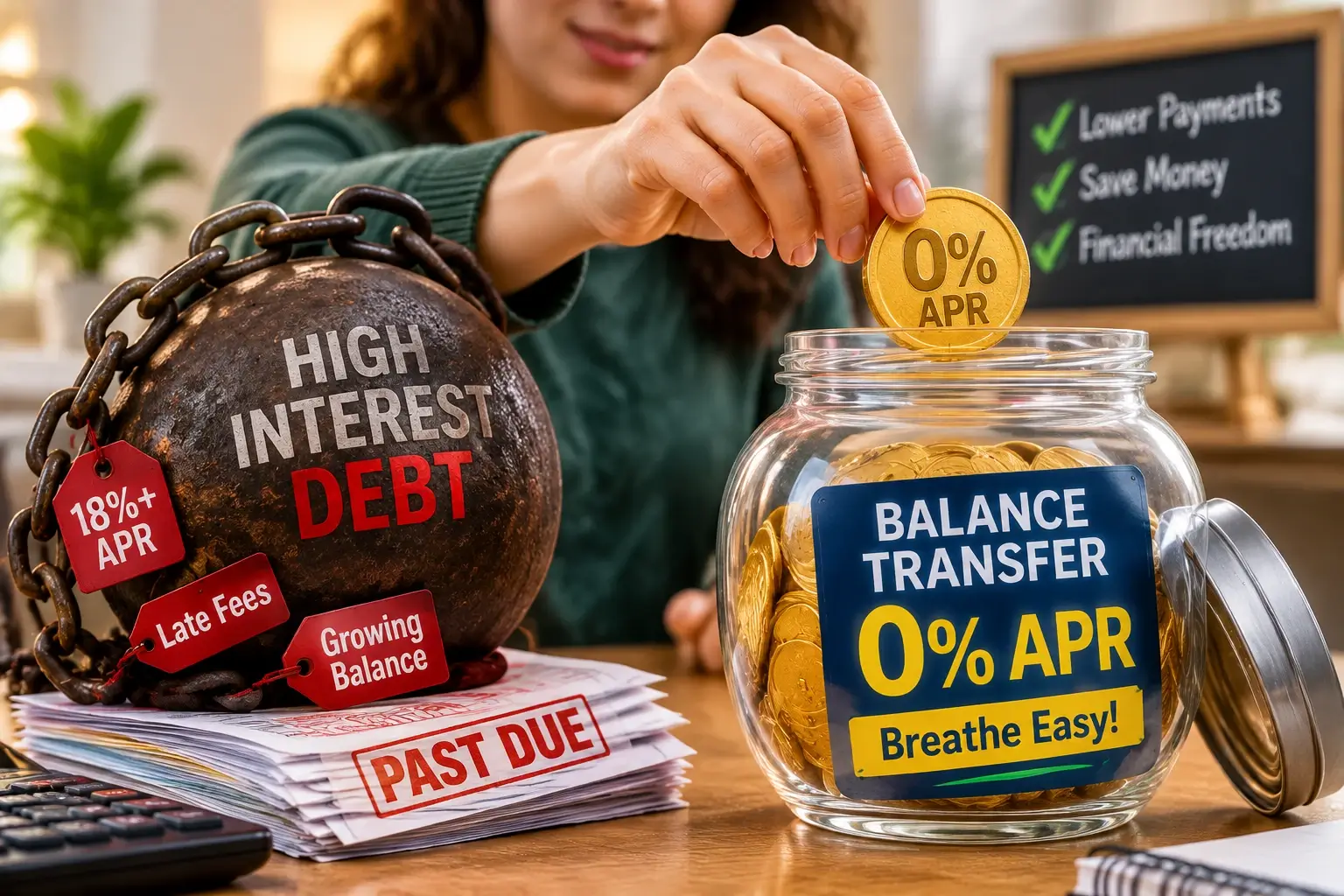
A balance transfer credit card can be one of the most cost-effective credit card consolidation options when used correctly.
Some credit card issuers offer an introductory period with 0% APR on transferred balances.
This means you temporarily pay no interest on eligible transferred debt during the promotional period, provided you follow the card's terms.
Imagine moving a $5,000 balance from a credit card charging 24% APR to a new card offering 0% APR for 15 months.
Instead of continuing to accumulate interest at 24%, you get a limited window to reduce the balance without additional interest on the transferred amount.
Sounds attractive, right?
It can be, but the numbers matter.
A Realistic $5,000 Balance Transfer Example
Let's calculate the potential savings.
Assume:
- Existing credit card balance: $5,000.
- Existing APR: 24%.
- New promotional APR: 0%.
- Promotional period: 15 months.
- Balance transfer fee: 3%.
- The transfer fee is:
- $5,000 × 3% = $150.
Now consider a minimum-payment scenario where the original card charges monthly interest and the borrower pays down approximately 1% of the outstanding principal each month.
Under that illustrative repayment model, the existing card would generate approximately $1,399 in interest over 15 months.
With the balance transfer, the promotional interest is $0, but the borrower pays a $150 transfer fee.
Estimated financing-cost savings: approximately $1,249.
| Description | Existing Card | Balance Transfer |
|---|---|---|
| Starting balance | $5,000 | $5,000 |
| APR | 24% | 0% |
| Promotional period | N/A | 15 months |
| Interest under the example | $1,399 | $0 |
| Transfer fee | $0 | $150 |
| Net interest-cost advantage | — | Approximately $1,249 |
The calculation assumes the same dollar payments continue after the transfer, and that the existing card's minimum-payment formula is interest plus approximately 1% of outstanding principal. Actual issuer formulas differ.
There is another important distinction: if you instead repay the entire $5,000 through 15 equal monthly payments, the original 24% card would generate approximately $837 in interest. After the $150 transfer fee, the net saving would be approximately $687.
So, the actual benefit depends heavily on how you repay the balance.
What Happens After the 0% Period Ends?
This is where borrowers sometimes get into trouble.
Once the promotional period expires, the remaining balance generally starts accruing interest at the card's applicable regular APR.
If you haven't paid off the transferred balance, your borrowing costs could increase substantially.
Before applying, check:
- How many months the 0% introductory rate lasts.
- The balance transfer fee.
- The regular APR after the promotional period.
- Whether the promotional rate applies to balance transfers specifically.
- The minimum payment requirements.
- The consequences of late payments.
The CFPB explains that balance transfer offers have limited promotional periods, fees, and conditions that borrowers should understand before applying.
Read the CFPB's balance transfer guidance.
Best for: Borrowers with good credit who qualify for a suitable promotional offer and can make meaningful payments before the introductory APR expires.
Option 3: Home Equity Loans and HELOCs
If you own a home, you may have another borrowing option: using your home equity to consolidate debt.
Home equity is the difference between your home's current market value and the outstanding mortgage balance secured by it.
For example, if your property is worth $350,000 and you owe $220,000 on your mortgage, you have approximately $130,000 in equity.
Some lenders allow eligible homeowners to borrow against this equity.
There are two common products.
A. Home Equity Loans
A home equity loan provides a lump sum of money against your property's equity.
You receive the funds upfront and repay them through scheduled installments.
Most home equity loans have fixed interest rates, meaning your interest rate generally remains unchanged throughout the repayment period.
You could use the money to pay off multiple credit cards, leaving you with one new loan payment.
B. Home Equity Lines of Credit (HELOCs)
A HELOC, or Home Equity Line of Credit, works more like a credit card.
Instead of receiving all the money upfront, the lender gives you access to a borrowing limit based on your available home equity.
You can withdraw money during the permitted borrowing period, known as the draw period.
Many HELOCs have variable interest rates, which means your borrowing costs can change over time.
After the draw period ends, you generally enter the repayment period. Your monthly payments may increase because you must begin repaying the principal as well as interest.
The CFPB explains these differences in its HELOC consumer guide and home equity loan guide.
Why Home Equity Borrowing Can Be Attractive
The interest rate may be lower than the rates on unsecured credit cards.
Depending on the terms, a home equity product may also offer a longer repayment period and a lower monthly payment.
However, there's a major downside.
The Serious Risk: You Could Lose Your Home

This is not a small detail.
When you use a home equity loan or HELOC to consolidate credit card debt, you're converting unsecured debt into debt secured by your home.
If you stop making payments, the lender may have the legal right to foreclose on your property.
In other words, a credit card company generally cannot take your home simply because you haven't paid your credit card balance. A home equity lender may be able to foreclose if you default on the secured loan.
You should also consider closing costs, appraisal fees, variable interest rates, and possible payment increases.
Best for: Homeowners with sufficient equity, stable income, and a reliable repayment plan who fully understand the risk of using their property as collateral.
Our advice: Don't put your home at risk simply to make credit card payments feel more manageable. Explore unsecured alternatives first.
Option 4: 401(k) Loans
A 401(k) loan allows eligible employees to borrow money from their employer-sponsored retirement savings plan.
You essentially borrow against your own retirement account and repay the money, usually through payroll deductions.
It may seem appealing because you aren't applying for a traditional bank loan.
However, this option deserves serious caution.
How Does a 401(k) Loan Work?
Not every retirement plan allows loans.
If your employer's plan permits borrowing, IRS rules generally allow eligible participants to borrow up to the lesser of:
- $50,000, or
- 50% of their vested account balance.
- Special rules and exceptions may affect the amount available.
Most general-purpose 401(k) loans must be repaid within five years, with substantially equal payments made at least quarterly.
The interest paid generally goes back into your retirement account.
You can read the official rules in the IRS 401(k) loan guidance.
The Double-Taxation Question
You may have heard that 401(k) loans involve double taxation.
The explanation is more complicated than the common warning suggests.
A qualifying 401(k) loan is generally not taxed when you receive the money.
Repayments are made using after-tax income. The principal is not simply taxed twice; the tax treatment follows the normal rules for retirement contributions and distributions.
However, the interest portion can create a genuine double-taxation concern because it is paid with after-tax money and may later be included in taxable traditional 401(k) distributions.
The Federal Reserve has discussed this issue in its research on 401(k) borrowing.
The larger financial concern is often the potential loss of investment growth while the money is outside your retirement investments.
What If You Leave Your Job?
This is one of the biggest risks.
Your employer's plan may require you to repay the outstanding balance when you leave your job.
If you cannot repay the amount and the plan treats the unpaid balance as a distribution, you may owe ordinary income tax.
If you are younger than 59½, an additional 10% early-distribution tax may also apply unless an exception is available.
Certain qualified plan loan offsets resulting from employment separation may be eligible for rollover by the federal income tax filing deadline, including extensions, for the relevant tax year.
These rules are explained by the IRS plan loan offset guidance.
Best for: This is generally not a first-choice debt consolidation option. Consider it only after carefully evaluating the retirement, employment, and tax consequences and comparing safer alternatives.
Option 5: Non-Profit Debt Management Plans (DMPs)
What if your credit score isn't strong enough to qualify for a personal loan or an attractive balance transfer card?
You may still have options.
A Debt Management Plan (DMP) is a repayment arrangement developed with the help of a credit counseling organization.
It can help you manage multiple unsecured debts through one structured monthly payment.
Unlike a consolidation loan, a DMP generally doesn't involve borrowing new money.
Instead, a credit counselor works with your creditors to establish a repayment arrangement.
How Does a DMP Work?
Let's say you owe money to four credit card companies.
You contact a nonprofit credit counseling organization.
A counselor reviews your income, expenses, debts, and ability to make payments.
If a DMP is suitable, the counselor may work with participating creditors to negotiate:
- Lower interest rates.
- Reduced or waived certain fees.
- More manageable monthly payments.
- A structured repayment schedule.
You generally make one payment to the counseling organization, which distributes the money to your participating creditors according to the agreed plan.
Does a DMP Eliminate Your Debt?
No.
This is an important distinction.
A DMP doesn't automatically erase your outstanding balances. You remain responsible for repaying the debts included in the plan.
Some organizations charge setup or monthly administration fees, so request a complete written fee schedule before enrolling.
Also, confirm that your creditors have accepted the proposed arrangement before sending payments to the organization handling your plan.
The CFPB provides useful information about credit counseling and debt management plans.
DMP vs. Debt Settlement
These two services are frequently confused.
A debt management plan helps you repay your debts through an organized payment arrangement.
Debt settlement involves attempting to negotiate a reduced amount with creditors, often while payments are stopped or delayed.
Debt settlement can result in additional interest, late fees, collection activity, and credit damage.
Be particularly careful with companies promising to eliminate your debt for a fraction of what you owe.
For additional information, read our guide to Debt Relief Programs.
Best for: People struggling with multiple unsecured debts who need professional budgeting support, creditor negotiations, and a structured repayment plan.
Option 6: Credit Card Issuer Hardship Programs
Here's an option many borrowers overlook.
Before applying for another loan, contact your existing credit card companies.
Your current creditors may have hardship programs designed to help customers experiencing financial difficulties.
These programs can sometimes provide temporary relief without requiring you to open another account.
What Can a Hardship Program Offer?
Depending on the issuer and your financial circumstances, you may be able to request:
- A temporarily reduced interest rate.
- Lower monthly payments.
- Waived late-payment fees.
- A modified payment schedule.
- Temporary payment relief.
For example, imagine your credit card charges 25% APR and you have recently experienced a reduction in income.
You contact the issuer, explain your situation, and ask whether a hardship arrangement is available.
The company may offer a temporary reduction in interest or a more manageable repayment schedule.
Approval and program conditions vary.
How to Ask for Help
Call the customer service number on the back of your credit card.
Ask to speak with the hardship department or a representative who handles payment assistance.
Be prepared to explain:
- Your current financial situation.
- Why you are struggling to make payments.
- How much you can realistically afford each month.
- Whether your financial difficulty is temporary or ongoing.
- Ask for all agreed terms in writing.
Also, check whether enrollment affects your ability to use the card, whether interest continues to accrue, and whether the issuer reports the arrangement to credit bureaus.
Best for: Borrowers experiencing temporary financial hardship who want to negotiate directly with existing creditors before taking on new debt.
Option 7: Debt Avalanche or Debt Snowball (Without Taking a New Loan)
Not everyone needs a new financial product to get out of debt.
If your income allows you to make your existing payments, you may be better off using a structured repayment strategy.
Two popular approaches are the debt avalanche method and the debt snowball method.
Neither is technically debt consolidation, but both are useful alternatives when borrowing more money isn't necessary.
Debt Avalanche Method
The debt avalanche method focuses on eliminating the debt with the highest interest rate first.
Here's an example:
| Debt | Balance | APR |
|---|---|---|
| Card A | $3,000 | 27% |
| Card B | $5,000 | 24% |
| Card C | $2,000 | 18% |
You continue making minimum payments on all three accounts.
Any additional money goes toward Card A because it has the highest interest rate.
Once Card A is paid off, you redirect that payment toward Card B.
You continue until every debt is eliminated.
Main advantage: You generally pay less interest when following the same repayment budget because you target the most expensive debt first.
Debt Snowball Method
The debt snowball method works differently.
You start by paying off the smallest balance, regardless of its interest rate.
For example:
- Pay off the $2,000 balance first.
- Then focus on the $3,000 balance.
- Finally, eliminate the $5,000 balance.
- The advantage is psychological motivation.
- Every time you eliminate an account, you achieve a visible milestone.
For someone who feels overwhelmed by multiple payments, that progress can make it easier to stay consistent.
Best for: Borrowers who can afford their current payments and want to eliminate debt without opening new credit accounts or paying consolidation fees.
The Real Math: Is Consolidation Worth It?
Let's compare two different approaches to paying off $15,000 in credit card debt.
This is where consolidation can make a substantial difference.
Scenario A: Keeping Your Existing Credit Card Debt
Assume:
- Total credit card debt: $15,000.
- APR: 24%.
- Monthly interest rate: 2%.
Minimum payment: Monthly interest plus 1% of the outstanding balance, or $35, whichever is greater.
The initial monthly interest is:
- $15,000 × 2% = $300.
- The initial minimum payment is approximately:
- $300 + $150 = $450.
- However, the minimum payment gradually decreases as the balance falls.
Under this illustrative minimum-payment formula, the debt takes approximately 245 months, or just over 20 years, to eliminate.
Total interest paid is approximately $26,535.
Scenario B: Taking a Five-Year Debt Consolidation Loan
Now imagine qualifying for a $15,000 personal consolidation loan with:
- Loan amount: $15,000.
- APR: 11%.
- Repayment period: 60 months.
- Fixed monthly payments.
- No additional origination fee.
- Your monthly payment would be approximately $326.14.
- Total repayment:
- $326.14 × 60 = approximately $19,568.
- Total interest:
- $19,568 − $15,000 = approximately $4,568.
Side-by-Side Comparison
| Financial Detail | Credit Card Minimums | Consolidation Loan |
|---|---|---|
| Starting debt | $15,000 | $15,000 |
| Interest rate | 24% | 11% |
| Initial monthly payment | $450 | $326.14 |
| Repayment period | 245 months | 60 months |
| Total interest | $26,535 | $4,568 |
| Total repayment | $41,535 | $19,568 |
Illustrative calculations. The credit card estimate assumes interest plus 1% of the remaining principal, subject to a $35 minimum payment. Actual card issuers use different minimum-payment formulas. The loan calculation assumes a fixed 11% nominal annual rate with monthly amortization and no additional fees. Figures are rounded.
How Much Could You Save?
Under these assumptions:
- $26,535 − $4,568 = $21,967 in potential interest savings.
- You would also eliminate the debt approximately 15 years sooner.
- That's a significant difference.
- However, there's a catch.
The 11% loan is only beneficial if you actually qualify for it and the complete cost, including origination fees and other charges, remains lower than your existing debt.
If a lender offers you 22% instead of 11%, the savings will be considerably smaller.
The lesson: Always compare total interest, fees, monthly payments, and repayment time before deciding whether consolidation is worth it.
How to Choose the Right Debt Consolidation Option for You
There isn't one perfect solution for every borrower.
The best debt consolidation options depend on your creditworthiness, financial stability, debt amount, and repayment goals.
Here's a practical decision framework.
If Your Credit Score Is 700 or Higher
Start by comparing 0% balance transfer credit cards and unsecured personal loans.
A credit score of 700 or above can be a useful shopping benchmark, but it isn't a guaranteed approval threshold.
Lenders also consider your income, existing debt, credit history, and other factors.
If you can repay your balance within the promotional period, a balance transfer may offer significant interest savings.
If You Want Predictable Monthly Payments
Consider a fixed-rate personal consolidation loan.
This may be especially useful if you have several credit cards with different payment deadlines and high interest rates.
Compare the total loan cost before accepting an offer.
If You Own a Home and Have Equity
You could investigate a home equity loan or HELOC.
However, make sure you understand that your home becomes collateral.
Don't choose this option solely because the interest rate appears lower.
The risk of foreclosure must be part of your decision.
If You Cannot Qualify for a Traditional Loan
Explore a nonprofit Debt Management Plan.
A credit counselor may help you negotiate with participating creditors and develop a repayment arrangement based on your actual budget.
You can also contact your existing creditors directly to ask about hardship programs.
If You Can Afford Your Current Minimum Payments
Consider the debt avalanche method.
You may not need a new loan at all.
Instead, direct extra money toward your highest-interest debt and gradually eliminate your balances.
A Quick Comparison
| Your Situation | Option Worth Exploring |
|---|---|
| Strong credit and manageable repayment timeline | 0% balance transfer |
| Multiple high-interest debts | Personal consolidation loan |
| Homeowner with sufficient equity | HELOC or home equity loan |
| Retirement savings and few alternatives | Carefully evaluate 401(k) loan |
| Difficulty qualifying for new credit | Nonprofit DMP |
| Temporary financial hardship | Creditor hardship program |
| Can afford payments without borrowing | Debt avalanche or snowball |
How to Consolidate Debt: A Step-by-Step Plan
Once you've identified a suitable option, don't rush into an application.
Follow these steps to avoid unnecessary fees and expensive mistakes.
Step 1: List Every Debt You Owe
Create a simple spreadsheet containing:
- Creditor name.
- Outstanding balance.
- Current APR.
- Minimum monthly payment.
- Payment due date.
- Calculate your total outstanding debt.
- This gives you a clear starting point.
If you want help comparing repayment timelines after you list those balances, try our debt payoff calculator.
Step 2: Review Your Credit Reports
Check your credit reports before applying.
Look for inaccurate balances, unfamiliar accounts, missed payments, and other reporting errors.
In the United States, you can access your credit reports through AnnualCreditReport.com.
Understanding your credit history can help you determine which lenders and products may be realistic options.
Step 3: Calculate Your Affordable Monthly Payment
Don't choose a loan simply because the lender approves it.
Work out how much you can comfortably pay after covering housing, food, utilities, transportation, insurance, and other essential expenses.
Your repayment plan should leave room for unexpected costs.
Step 4: Compare Multiple Offers
Get quotes from different lenders.
Where available, use prequalification tools that allow you to check potential rates without a hard credit inquiry.
A hard inquiry generally occurs when you formally apply for credit and can temporarily affect your credit score.
The CFPB explains the difference between hard and soft credit inquiries in its credit inquiry guide.
Step 5: Compare the Complete Cost
Don't focus exclusively on monthly payments.
Check:
- APR.
- Origination fees.
- Balance transfer fees.
- Repayment term.
- Late fees.
- Variable interest rate conditions.
- Total amount repayable.
A longer loan may reduce your monthly payment while increasing the amount of interest you pay overall.
Step 6: Pay Off Your Existing Debts and Stop Adding New Ones
If you receive a consolidation loan, use the proceeds to pay off the debts you intended to consolidate.
Verify that each creditor has received the payment and that the accounts show the correct balances.
Then establish a budget and avoid rebuilding the credit card balances you just eliminated.
A simple spending reset helps: start with our budgeting tips for 2026 and a clear list of budget categories.
This final step is what makes consolidation a long-term solution rather than a temporary rearrangement.
The Hidden Risks of Debt Consolidation
Debt consolidation can help, but it can also create additional financial problems if you don't understand the risks.
Let's look at the most important ones.
1. You Could End Up With More Debt
This is probably the biggest mistake borrowers make.
Imagine you have $10,000 in credit card debt.
You take out a $10,000 consolidation loan and pay off all your cards.
But instead of changing your spending habits, you start using those credit cards again.
A few months later, you have:
- A $10,000 personal loan.
- Another $5,000 in credit card balances.
- You now owe $15,000 instead of $10,000.
- Consolidation didn't solve the underlying problem.
- It simply created additional borrowing capacity.
2. Lower Monthly Payments Can Mean Higher Total Costs
A lender might advertise a much smaller monthly payment.
That sounds appealing, especially when money is tight.
But if you extend your repayment period from three years to seven years, you may pay substantially more interest.
Always calculate the total repayment amount before accepting the offer.
3. Your Credit Score May Temporarily Decrease
Applying for a new loan or credit card can result in a hard inquiry.
Opening a new account can also affect your credit profile.
However, successfully paying off credit card balances may reduce your credit utilization ratio, which can benefit your credit score.
Credit utilization is the percentage of your available revolving credit that you're currently using.
For example, if you have $10,000 in available credit and owe $8,000, your utilization ratio is 80%.
Paying down revolving balances can help reduce that percentage.
Be careful about closing every paid-off card immediately. Closing accounts can reduce your total available credit and potentially increase your utilization ratio.
The CFPB explains this in its guide to closing credit card accounts.
4. You May Lose Promotional Benefits
Balance transfer offers don't last forever.
If you still have an outstanding balance after the introductory period, the regular APR may apply.
Missing payments can also have consequences under the account agreement.
Always understand what happens when the promotional period ends.
5. You Could Put Your Property or Retirement at Risk
Home equity products put your home at risk if you cannot repay the debt.
401(k) loans can reduce retirement investment growth and create tax consequences if repayment requirements aren't met.
These options should never be selected solely because their advertised rates appear attractive.
6. Debt Relief Scams Can Make Your Situation Worse
Be careful when companies promise to eliminate your debt quickly or guarantee that you will qualify for a special program.
Some debt settlement companies encourage borrowers to stop paying creditors, potentially resulting in additional interest, collection activity, and credit damage.
The Federal Trade Commission (FTC) warns consumers about companies that demand upfront fees before providing promised debt relief services.
Read the FTC's debt relief scam guidance.
A legitimate financial solution should be transparent about its fees, limitations, and risks.
Remember: Debt consolidation treats the structure of your debt. It does not automatically fix the spending habits or financial circumstances that created it.
Frequently Asked Questions (FAQ)
Does Debt Consolidation Hurt Your Credit?
Debt consolidation can initially cause a temporary decrease in your credit score.
Applying for a new personal loan or balance transfer credit card may create a hard inquiry. Opening a new account can also affect your credit profile.
However, paying off existing credit card balances may lower your credit utilization ratio.
Making consistent, on-time payments on your new loan can also support a healthier credit history over time.
The overall impact depends on your credit profile, repayment behavior, and the type of consolidation product you choose.
Can I Consolidate Debt With Bad Credit?
Yes, you may have options even if your credit score is low.
However, qualifying for an unsecured personal loan or a 0% balance transfer card may be more difficult.
Consider exploring:
- Nonprofit credit counseling.
- Debt Management Plans.
- Credit card hardship programs.
- Personal loans from eligible credit unions.
- Direct repayment arrangements with existing creditors.
Be cautious of lenders advertising guaranteed approval or extremely low rates regardless of credit history.
Compare the complete borrowing cost before signing anything.
Is It Better to Consolidate or Pay Off Debt?
It depends on your financial situation.
Consolidation may be better when you qualify for a lower interest rate, want predictable payments, and need to simplify several debts.
Direct repayment may be better if you can afford your existing payments and don't need another loan.
For example, the debt avalanche method can help you eliminate high-interest balances without paying a consolidation fee or opening a new account.
The best decision is the one that reduces your total borrowing cost and gives you a realistic path toward becoming debt-free.
Conclusion: Choose a Debt Consolidation Plan You Can Actually Finish

Carrying multiple high-interest debts can feel exhausting.
Between minimum payments, interest charges, and different due dates, it's easy to feel like you're working hard without making meaningful progress.
But you do have options.
A personal consolidation loan, a 0% balance transfer card, a nonprofit Debt Management Plan, or a creditor hardship arrangement may help you regain control of your finances.
The important thing is choosing an option that fits your actual budget.
Don't rush into a loan because the monthly payment looks attractive. Don't put your home or retirement savings at risk without carefully considering the consequences.
Start by listing your debts, checking your interest rates, and calculating how long each repayment option will take.
Then compare the total cost of your available choices.
Most importantly, create a realistic spending plan so you don't accumulate new balances after consolidating your existing debt.
You don't need to solve every financial problem overnight. You need a clear repayment strategy, consistent payments, and a plan you can stick with.
One manageable step at a time can move you closer to financial freedom.
About the Author
Syed Hamza Hasnain, Founder and Editor. Read more about MoneyPulsar, how we research and review content in our Editorial Policy, and our Financial Disclaimer.

Syed Hamza Hasnain · Founder & Editor
Syed Hamza Hasnain is the Founder and Editor of MoneyPulsar. He researches and edits practical guides on budgeting, debt payoff, index investing, and retirement planning across our US and Pakistan tracks using primary regulatory sources. Learn more about our editorial process →