
Disclaimer: This article is for educational purposes only and does not constitute financial advice. Read our full financial disclaimer.
Ever looked at your bank account on the 28th of the month and thought, “Where did all my money go?”
Your paycheck came in. You paid rent, bought groceries, filled up the car, grabbed coffee a few times, and handled a couple of unexpected expenses. Nothing crazy. Nothing you would call reckless.
Yet somehow, there’s barely anything left.
One of the biggest problems with money isn’t necessarily how much you earn. It’s how little control you have over where it goes.
That’s where zero based budgeting comes in.
Think of it like giving every dollar in your paycheck a specific assignment before you spend it. Your rent gets covered. Your groceries get funded. Your savings account gets something. Your debt gets paid down. And yes, you even leave room for enjoying yourself.
The idea is simple: your income minus all your planned expenses, savings, and debt payments should equal zero.
This is sometimes called a 0 base budgeting plan. It’s also the approach used by popular debt-free budgeting communities, including many people who follow Dave Ramsey’s budgeting philosophy.
Here’s the thing. You don’t need a six-figure salary, a finance degree, or a fancy spreadsheet to make this work.
You just need a plan.
This guide is for US readers and covers personal budgets only. (Businesses also use “zero-based budgeting,” but that is a different process for company spending and isn’t covered here.)
Let’s build one together.
Table of Contents (tap to open)
Table of Contents
What Is Zero-Based Budgeting? (A Simple Definition)
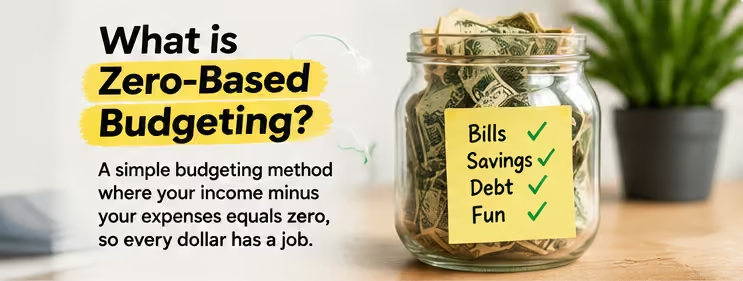
Zero-based budgeting is a money management method where you assign every dollar of your take-home income to a specific purpose until your planned income minus your allocations equals zero. Every dollar gets assigned to expenses, savings, debt repayment, investments, or personal spending before you use it.
And no, zero doesn’t mean your bank account is empty.
It means you haven’t left any money without a job.
For example, imagine you earn $3,500 a month after taxes. You might assign:
- $1,100 to rent.
- $400 to groceries.
- $250 to transportation.
- $300 to savings.
- $500 to debt payments.
- $200 to entertainment.
- The remaining $750 to utilities, insurance, subscriptions, medical expenses, and other categories.
Once every dollar has an assignment, your unallocated balance is zero.
Your money still exists. It’s simply accounted for.
What does zero based budgeting actually mean?
Imagine you receive $100.
Without a budget, you might spend $30 on groceries, $20 on lunch, $15 on an online purchase, and another $10 on something you didn’t plan.
You look at your account later and wonder where the remaining money went.
With zero-based budgeting, you decide what those $100 need to accomplish before spending them.
Maybe $40 goes toward groceries, $20 toward a utility bill, $15 toward savings, $15 toward debt, and $10 toward personal spending.
Every dollar has a purpose.
That’s the entire idea.
And there’s one thing to make clear: savings contributions and debt payments count as assignments. You aren’t expected to spend every dollar on shopping, bills, and groceries.
You’re deciding where your money belongs.
How Does Zero-Based Budgeting Actually Work? (Real Math Example)
Let’s stop talking about theory and look at a realistic monthly budget.
Meet Sarah.
Sarah takes home $4,000 every month after taxes. She rents an apartment, owns a car, has some credit card debt, and wants to build her savings.
She isn’t earning a fortune. She also isn’t terrible with money.
She just wants to stop reaching the end of every month with nothing to show for her paycheck.
Here’s how she could organize her income.
Sarah’s $4,000 monthly zero-based budget
| Budget category | Monthly allocation |
| Rent | $1,200 |
| Groceries | $400 |
| Utilities | $150 |
| Transportation payment/transit | $250 |
| Gas | $100 |
| Car insurance | $120 |
| Phone and internet | $120 |
| Medical expenses | $80 |
| Subscriptions | $50 |
| Personal and household expenses | $130 |
| Gifts and charitable giving | $100 |
| Emergency savings | $300 |
| Debt payments | $500 |
| Entertainment and dining out | $200 |
| Car repairs and annual expenses fund | $250 |
| Miscellaneous buffer | $50 |
| Total allocated | $4,000 |
Now look at the calculation.
| Description | Amount |
| Monthly take-home income | $4,000 |
| Total planned allocations | -$4,000 |
| Unallocated money | $0 |
Sarah has successfully created a zero-based budget.
Notice something important?
She hasn’t eliminated entertainment. She hasn’t stopped buying things she enjoys. She hasn’t put every spare dollar toward debt.
She has simply decided how much she can afford to spend in each category.
Why does Sarah need a miscellaneous buffer?
Let’s say Sarah’s monthly budget is almost perfect.
Then her kitchen faucet starts leaking. She needs to buy a replacement part, and it costs $35.
Without a buffer, she might use her credit card or take money away from an important bill.
But Sarah already assigned $50 to miscellaneous expenses.
She can cover the repair without destroying the rest of her budget.
That’s why a small buffer category helps whenever possible.
It gives your budget some breathing room.
What happens if Sarah doesn’t spend all her money?
Suppose Sarah spends only $30 of her $50 miscellaneous allocation.
She has $20 remaining.
She can leave it in the category, transfer it to emergency savings, or use it toward debt in her next budget review.
The goal isn’t to spend everything.
The goal is to account for everything.
More Zero-Based Budget Examples at Different Incomes
Sarah’s plan is one illustration. Below are three more worked budgets at different take-home pay levels. They’re illustrations to copy and adjust, not typical figures and not recommendations. Except for the USDA grocery lines, the amounts are made-up inputs chosen to show the method.
Example 1: $2,000 a month take-home, single renter (illustrative)
This example shows that a tight budget can still balance to $0 with a buffer, savings and a yearly-cost line, but every dollar is stretched.
Illustrative example. Rent, utilities, transportation and other non-grocery lines are made-up inputs; no source is implied. The $2,000 take-home is also a chosen input.
| Line | Monthly amount |
| Take-home pay | $2,000 |
| Rent | $950 |
| Utilities (electric, gas, water) | $110 |
| Phone | $45 |
| Internet | $50 |
| Renters insurance | $15 |
| Transportation (transit pass, rides) | $130 |
| Groceries (USDA Thrifty plan, 1 adult)¹ | $305 |
| Household and toiletries | $35 |
| Health costs (copays, prescriptions) | $30 |
| Credit card minimum payment | $60 |
| Sinking fund: yearly costs ($600 a year ÷ 12) | $50 |
| Emergency fund | $100 |
| Clothing | $20 |
| Fun and personal spending | $60 |
| Buffer (“oops” line) | $40 |
| Total assigned | $2,000 |
| Left to assign | $0 |
¹ Groceries: USDA Thrifty Food Plan, U.S. average, September 2026 (issued October 2026). Female, 20–50 years: $253.90 a month. USDA suggests adding 20% for a one-person household, so $253.90 × 1.20 = $304.68, rounded up to $305 (USDA Food Plans). The plan assumes all meals and snacks are made at home.
How it balances to $0: $950 + $110 + $45 + $50 + $15 + $130 + $305 + $35 + $30 + $60 + $50 + $100 + $20 + $60 + $40 = $2,000. Take-home − assigned = $0.
If income dropped $200 (illustrative): At $1,800, these lines shrink: emergency fund −$80 (to $20), fun −$30 (to $30), clothing −$20 (to $0), yearly-costs fund −$20 (to $30), phone −$20 (to $25), buffer −$15 (to $25) and household −$15 (to $20). That’s −$200 total, so $1,800 − $1,800 = $0. Nothing is left to cut without touching rent, food or bills.
Example 2: $3,500 a month take-home, single parent with one child (illustrative)
This example adds child care and kids’ costs, and uses leftover dollars for an extra debt payment and savings.
Illustrative example. All non-grocery lines and the $3,500 take-home are made-up inputs; no source is implied.
| Line | Monthly amount |
| Take-home pay | $3,500 |
| Rent | $1,350 |
| Utilities | $160 |
| Phone | $60 |
| Internet | $60 |
| Renters insurance | $18 |
| Car insurance | $130 |
| Gas | $140 |
| Child care / after-school care | $300 |
| Groceries (USDA Low-Cost plan, parent + child age 6–8)² | $592 |
| Household and toiletries | $60 |
| Child’s clothes and school costs | $50 |
| Health costs | $50 |
| Credit card minimum payment | $75 |
| Extra credit card payment | $50 |
| Sinking fund: car repairs and registration ($900 a year ÷ 12) | $75 |
| Sinking fund: holidays and birthdays ($480 a year ÷ 12) | $40 |
| Emergency fund | $150 |
| Fun and personal spending | $90 |
| Buffer (“oops” line) | $50 |
| Total assigned | $3,500 |
| Left to assign | $0 |
² Groceries: USDA Low-Cost Food Plan, U.S. average, September 2026 (issued October 2026). Female, 19–50 years: $276.30; child, 6–8 years: $261.50. Sum $537.80, plus 10% for a two-person household = $591.58, rounded up to $592 (USDA Food Plans).
How it balances to $0: line total = $3,500. Take-home − assigned = $0.
If income dropped $200 (illustrative): At $3,300, drop the extra credit card payment (−$50), lower the emergency fund (−$100, to $50) and cut fun (−$50, to $40). Total −$200. The minimum payment, child care and sinking funds stay.
Example 3: $5,500 a month take-home, two adults (illustrative)
This example has room for several goals, and the final $171 goes to an extra student loan payment so nothing is left unassigned.
Illustrative example. All non-grocery lines and the $5,500 take-home are made-up inputs; no source is implied.
| Line | Monthly amount |
| Take-home pay (combined) | $5,500 |
| Rent | $1,800 |
| Utilities | $200 |
| Phones (2 lines) | $100 |
| Internet | $65 |
| Renters insurance | $20 |
| Car payment | $380 |
| Car insurance (2 drivers) | $220 |
| Gas | $200 |
| Groceries (USDA Moderate-Cost plan, 2 adults 19–50)³ | $809 |
| Household and toiletries | $80 |
| Health costs | $80 |
| Student loan payment | $250 |
| Sinking fund: car maintenance and registration ($1,200 a year ÷ 12) | $100 |
| Sinking fund: holidays and gifts ($900 a year ÷ 12) | $75 |
| Sinking fund: yearly subscriptions and memberships ($300 a year ÷ 12) | $25 |
| Emergency fund | $300 |
| Savings goal | $200 |
| Eating out and fun | $200 |
| Personal spending (2 × $75) | $150 |
| Buffer (“oops” line) | $75 |
| Extra student loan payment (the remainder) | $171 |
| Total assigned | $5,500 |
| Left to assign | $0 |
³ Groceries: USDA Moderate-Cost Food Plan, U.S. average, September 2026 (issued October 2026). Female, 19–50 years: $336.40; male, 19–50 years: $398.40. Sum $734.80, plus 10% for a two-person household = $808.28, rounded up to $809 (USDA Food Plans).
How it balances to $0: Before the last line, the assigned total is $5,329, so $171 is left. That $171 gets a job (an extra student loan payment). $5,329 + $171 = $5,500, and take-home − assigned = $0.
If income dropped $200 (illustrative): At $5,300, remove the extra student loan payment (−$171) and trim eating out and fun (−$29, to $171). Savings and sinking funds don’t change.
A note on the grocery lines: USDA updates these food plan costs every month. The figures above come from the September 2026 reports (issued October 2026), re-checked against the live USDA Food Plans page on November 9, 2026. USDA food plans are US averages, and costs in your area may be higher or lower. Alaska and Hawaii have their own Thrifty Food Plan costs, published separately by USDA (USDA Food Plans).
The Best Zero-Based Budgeting Apps (And Which to Avoid)
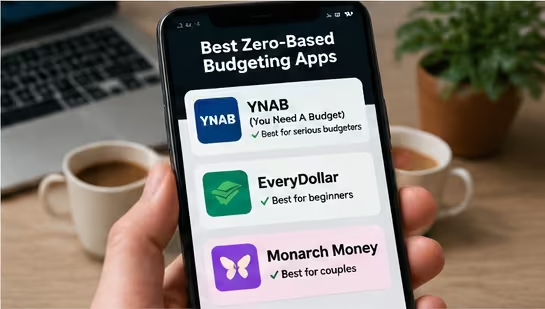
You don’t need an app to use zero-based budgeting.
A notebook, spreadsheet, or Google Sheet can do the job perfectly well.
But tracking every transaction manually can become annoying, especially when you’re managing multiple bills, savings goals, and debt payments.
That’s why a zero based budgeting app can make things easier.
Here are three options worth considering.
1. YNAB (You Need A Budget) — Best for serious budgeters
Best for: People who want to actively control their spending and build better financial habits.
YNAB is one of the best-known budgeting tools built around the idea of giving every dollar a job.
Instead of simply showing you where your money went, it encourages you to decide what your available money needs to accomplish.
Its approach includes:
- Assigning available money to budget categories.
- Preparing for larger, less frequent expenses.
- Adjusting your budget when unexpected costs appear.
- Building a financial cushion so you’re less dependent on your next paycheck.
The philosophy behind YNAB encourages you to work with the money you actually have rather than spending based on money you expect to receive next week.
The downside?
YNAB can have a learning curve.
If you’ve never used a detailed budgeting system before, the categories and funding process may feel overwhelming initially.
It is also a paid subscription. Its official pricing currently lists $109 per year or $14.99 per month, with a 34-day free trial. Prices may change.
Verdict: If you’re serious about changing your relationship with money and don’t mind spending time learning a system, YNAB deserves a look.
Website: https://www.ynab.com/
2. EveryDollar — Best for beginners
Best for: People who want a straightforward zero-based budgeting experience.
EveryDollar is a budgeting app from Ramsey Solutions.
Its approach is simple: create your monthly budget, assign every dollar, and track what you spend.
The free version allows you to:
- Create monthly budgets.
- Customize budget categories.
- Manually enter transactions.
- Set savings funds.
- Track bill due dates.
The Premium version adds features such as bank connections, automatic transaction imports, paycheck planning, reports, and financial goals.
The official website currently lists Premium at $79.99 annually.
One strength of EveryDollar is its straightforward design. You don’t need to spend hours learning complicated financial dashboards.
The downside?
The free version requires manual transaction entry. If you forget to record purchases, your budget can quickly become inaccurate.
Also, the mobile app and Premium subscription are limited to US users.
Verdict: If you’re completely new to zero-based budgeting, start by exploring the free version before paying for additional features.
Website: https://www.ramseysolutions.com/money/everydollar
3. Monarch Money — Best for couples and households
Best for: Couples who want to manage their household finances together.
Monarch Money takes a broader approach to personal finance.
It combines budgeting, account tracking, savings goals, debt tracking, investment monitoring, and financial reporting.
Some useful features include:
- Connecting multiple financial accounts.
- Tracking household spending.
- Setting savings and debt goals.
- Reviewing spending categories.
- Sharing financial information with a partner.
- Viewing household financial progress.
One particularly useful feature is household collaboration.
Each household member can have a separate login while sharing access to the household’s financial picture under one subscription.
Monarch offers traditional category budgeting as well as a more flexible budgeting approach.
Its official pricing page currently lists $99.99 a year or $14.99 a month, with a separate Plus tier (price not listed there), and your first week is free. Prices may change.
The downside?
Monarch offers many features, but that can feel like too much if all you want is a simple monthly spending plan.
It’s also a paid product.
Verdict: If you and your partner want to coordinate household bills, savings, debt and investments, Monarch is worth considering.
Website: https://www.monarch.com/
Which zero-based budgeting app should you choose?
| App | Best for | Free option | Main drawback |
| YNAB | Detailed budgeting | Free trial | Learning curve and subscription |
| EveryDollar | Beginners | Yes | Manual tracking in free version |
| Monarch Money | Couples and households | Free trial | Paid subscription |
Don’t subscribe to three apps.
Pick one that fits your situation, try it, and give yourself a month to learn the system.
If you’re struggling financially, start with a free spreadsheet rather than adding another monthly subscription to your bills.
The best budgeting app is the one you’ll actually use.
Zero-Based Budgeting vs. The 50/30/20 Rule: Which Is Better?
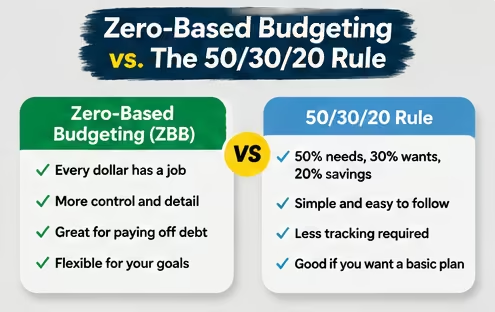
You’ve probably heard about the 50/30/20 budgeting rule.
It’s popular because it’s easy to understand.
The basic idea is to divide your after-tax income into three categories:
| Category | Percentage | What it covers |
| Needs | 50% | Housing, groceries, utilities and essential transportation |
| Wants | 30% | Entertainment, dining out, shopping and hobbies |
| Savings and financial goals | 20% | Savings, investments and debt reduction |
Let’s say you take home $4,000 a month.
Your rough allocation would look like this:
- $2,000 for needs.
- $1,200 for wants.
- $800 for savings and financial goals.
Simple, right?
You don’t need to track every individual purchase before deciding how much you can spend overall.
But here’s where zero-based budgeting is different.
Zero-based budgeting gives you more control
With the 50/30/20 rule, you know how much money should go toward each broad category.
With zero-based budgeting, you decide exactly where your money goes.
For example, instead of saying you have $2,000 for needs, you create individual categories for rent, groceries, insurance, utilities, and transportation.
This makes it easier to identify exactly where your money is going.
The 50/30/20 split is a rule of thumb, not a target everyone can or should hit. CFPB materials describe it as putting 50% of take-home pay toward needs, 20% toward savings and debt payments and no more than 30% toward wants, and say it’s only one rule to live by: not everyone can follow it (CFPB: My spending rule to live by; CFPB: Learning about budgets).
In Example 1 above, rent alone is 47.5% of take-home pay ($950 ÷ $2,000), so “needs” are well over 50%. That doesn’t mean the budget has failed; it means the percentages don’t fit that situation.
Which method is better if you’re paying off debt?
Zero-based budgeting often fits debt repayment better.
Why?
Because debt repayment often requires more intentional decisions.
You might discover that you’re spending $180 a month on subscriptions, takeout, and unnecessary purchases.
Once you see those numbers, you can decide whether to redirect some of that money toward your credit card balance.
The budget doesn’t magically eliminate debt.
It helps you identify where additional repayment money could come from.
If you need help deciding which debts to tackle first in your budget, try our Debt Payoff Calculator.
What if you hate tracking every penny?
Then the 50/30/20 rule might suit you better.
Not everyone wants to review 15 or 20 spending categories every month.
Some people prefer a simpler system.
That’s fine.
You don’t get a financial medal for using the most complicated budgeting method.
Choose the system you can maintain.
And remember, the 50/30/20 percentages are guidelines, not rules. If your rent takes up 55% of your income, forcing yourself into a 50% needs category won’t magically make housing cheaper.
Start with your actual circumstances.
You can also use both together: 50/30/20 to check the big picture, and a zero-based plan for the details. Neither method guarantees you’ll reach a goal. They are planning tools.
Pros and Cons of Zero-Based Budgeting (The Brutal Truth)
Zero-based budgeting is useful, but it requires effort.
Let’s look at both sides.
The advantages
#### 1. You know where your money goes
This is probably the biggest benefit.
Instead of wondering why your paycheck disappeared, you have a plan showing where every dollar was assigned.
You can see your rent, food, debt payments, savings, and entertainment spending in one place.
#### 2. It helps you identify unnecessary spending
You might think you’re only spending $50 a month on takeout.
But after tracking everything, you discover it’s closer to $180.
That’s the kind of information that can change your financial habits.
You can’t fix a spending problem you haven’t identified.
#### 3. It makes debt repayment more intentional
When you assign money to debt payments before spending on nonessentials, you make repayment part of your regular financial plan.
You’re no longer hoping to have money left over at the end of the month.
#### 4. It encourages regular savings
Savings becomes a planned category rather than something you do only when you have extra money.
You can create separate categories for:
- Emergency savings.
- Car repairs.
- Medical expenses.
- Annual insurance premiums.
- Holidays.
- Retirement contributions.
Small amounts add up over time.
#### 5. It gives you permission to spend
This one is underrated.
A budget shouldn’t make you feel guilty every time you buy something enjoyable.
If you’ve already covered your important expenses and assigned $150 to entertainment, you can use that money without wondering whether you’re making a terrible financial decision.
The disadvantages
#### 1. It takes time
Your first budget might take a couple of hours.
You’ll need to review bank statements, identify recurring payments, estimate grocery spending, and organize categories.
That’s not particularly exciting.
But the process usually gets easier once you understand your spending patterns.
#### 2. It can feel restrictive
If you’ve never tracked your money before, seeing every spending category can feel uncomfortable.
You might realize that some habits cost more than you thought.
Don’t use that information to punish yourself.
Use it to make better decisions.
#### 3. Irregular income makes budgeting harder
If you’re a freelancer, contractor, commission-based worker, or small business owner, your monthly income might change dramatically.
A budget based on earning $5,000 every month becomes a problem when you receive only $3,200.
For irregular income, budget around the money you’ve actually received rather than relying entirely on projected earnings.
Prioritize essential bills, groceries, minimum debt payments, and upcoming obligations first.
When additional income arrives, assign it to the next important category.
#### 4. Unexpected expenses can disrupt your plan
A car repair, medical bill, or family emergency can throw off your monthly allocations.
That’s normal.
A zero-based budget is not supposed to predict everything perfectly.
You can move money between categories when life changes.
The goal is to make those decisions consciously.
Is zero-based budgeting worth it?
Yes, if you want to stop leaking money and become more intentional about your financial decisions.
But don’t expect perfection.
A budget that you follow imperfectly is better than a perfect budget you abandon after five days.
How to Start Your First Zero-Based Budget (Step-by-Step)
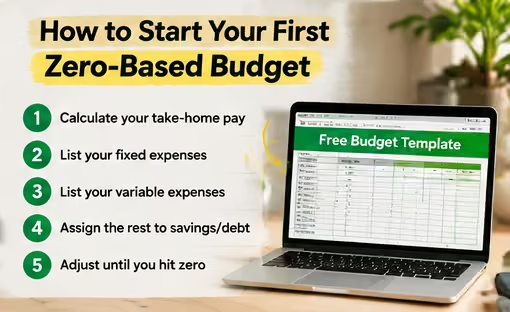
Ready to try it?
Let’s build your first budget.
You don’t need an expensive app. You can use a notebook, spreadsheet, or the free Google Sheets template linked below.
Government budgeting guides suggest a similar order. The Federal Trade Commission’s consumer.gov guide says to gather your bills and pay stubs, list your expenses and your income, then subtract your expenses from your income (consumer.gov: Making a Budget).
Step 1: Calculate your exact monthly take-home pay
Start with the money that actually reaches your bank account.
Not your gross salary.
Not your salary before taxes.
Your take-home pay.
If you receive $4,500 before taxes but only $3,600 reaches your account, your starting budget should generally use $3,600.
Include other reliable income sources, such as regular freelance payments or recurring side-hustle income. The CFPB’s Income and benefits tracker has rows for a second job, child support and benefits (CFPB: Income and benefits tracker).
If your income changes, use a conservative estimate for planning and avoid assigning money you haven’t received yet.
Step 2: List your fixed expenses
Fixed expenses are payments that are relatively predictable.
Write down:
- Rent or mortgage.
- Car payments.
- Insurance.
- Internet.
- Phone bills.
- Minimum debt payments.
- Subscriptions.
- Childcare.
Not sure which categories to use? See our budget categories list.
Check your bank statements.
Don’t rely on memory.
It’s surprisingly easy to forget a $12 subscription or an annual insurance payment.
Note when each bill is due, because a month can come up short when bill dates and paydays don’t line up. The CFPB’s cash flow budget tool is built to track that timing week by week.
Step 3: List your variable expenses
These expenses change depending on your habits and circumstances.
Examples include:
- Groceries.
- Gas.
- Restaurants.
- Clothing.
- Household supplies.
- Entertainment.
- Personal care.
- Medical expenses.
Look at your spending over the last two or three months.
Use realistic numbers.
If you normally spend $500 on groceries, don’t suddenly budget $200 just because you want to save money.
Start with reality.
You can adjust later.
Step 4: Assign the remaining money to savings and debt
Now subtract your planned expenses from your take-home income.
Whatever remains needs an assignment.
You might direct it toward:
- Emergency savings.
- Credit card debt.
- Student loans.
- Retirement contributions.
- A car replacement fund.
- Future travel.
- Other financial goals.
Don’t forget irregular expenses.
Your car will eventually need maintenance. Holidays arrive every year. Insurance premiums may be due annually.
Set aside smaller amounts throughout the year instead of scrambling when those bills arrive. Take a yearly cost, estimate the total, and divide by 12. That monthly amount is your sinking-fund line.
Once your budget is set, make sure you also have an emergency fund in place.
Step 5: Adjust until you hit zero
Now comes the final step.
Add up every allocation.
If your income is $3,600 and your total planned allocations are $3,450, you still have $150 without an assignment.
Give that money a job.
Maybe $100 goes toward debt and $50 toward emergency savings.
If your allocations total $3,750, you’re budgeting $150 more than you earn.
You’ll need to reduce some categories or find a realistic way to increase your income.
Keep adjusting until:
Income − Expenses − Savings − Debt Payments − Other Allocations = $0
That’s your zero-based budget.
Keep a small buffer line so a surprise charge doesn’t push your account below zero.
Your free zero-based budgeting template
Here’s a simple structure you can copy into Google Sheets.
| Category | Planned amount | Actual amount | Difference |
| Monthly take-home income | $ | $ | $ |
| Housing | $ | $ | $ |
| Groceries | $ | $ | $ |
| Utilities | $ | $ | $ |
| Transportation | $ | $ | $ |
| Insurance | $ | $ | $ |
| Phone and internet | $ | $ | $ |
| Medical expenses | $ | $ | $ |
| Debt payments | $ | $ | $ |
| Emergency savings | $ | $ | $ |
| Retirement savings | $ | $ | $ |
| Entertainment | $ | $ | $ |
| Personal expenses | $ | $ | $ |
| Sinking funds | $ | $ | $ |
| Miscellaneous buffer | $ | $ | $ |
| Total allocated | $ | $ | $ |
| Unallocated balance | $ | $ | $ |
Your goal is to bring the planned unallocated balance to zero.
Actual spending will naturally differ from your original plan. That’s why it’s important to review the numbers throughout the month.
Download our free zero-based budgeting template (Google Sheets). Click the link to make your own copy, enter your income, and start assigning your dollars.
You don’t need to make it complicated.
If you prefer paper or a printable form, the CFPB’s free Your Money, Your Goals toolkit includes an income and benefits tracker, a spending tracker, a bill calendar and a cash flow budget (CFPB toolkit), and the FTC offers a printable Budget Worksheet.
If you want 15 other ways to save money this month, check out our 15 budgeting tips to save more money each month.
Paid Weekly or Every Two Weeks? Budget by Paycheck
Short answer: build the monthly plan, then split the lines across your paychecks based on when each bill is due.
If you’re paid every two weeks, give each paycheck the bills due before your next payday. For example, rent might come from the first paycheck and the car payment and utilities from the second. The CFPB’s cash flow budget tool works the same way: it tracks money coming in and going out week by week so you can see whether you have enough to get through each week (CFPB: Creating a cash flow budget).
Months with a third paycheck
If you’re paid every two weeks, you usually get 26 paychecks a year (52 weeks ÷ 2; because a year is 52 weeks plus a day or two, some years have 27). That’s at least two more than 12 months × 2, so at least two months a year have three paydays. A simple approach is to build your regular budget on two paychecks and decide ahead of time what the third one is for, such as a sinking fund, the emergency fund or an extra debt payment. Weekly pay works the same way: most months have four paydays and some have five.
When a Zero-Based Budget Isn’t the Right Fit
Short answer: it may not suit you if detailed tracking makes you give up, or if your income is so irregular that a monthly plan keeps breaking. A simpler method may work better.
A zero-based budget takes regular attention. If that isn’t realistic right now, a simpler method with a few big categories, such as the 50/30/20 split above, may be easier to keep up.
If your budget can’t reach $0 even after cutting extras, the method is telling you something real: your current bills are bigger than your current pay. Cutting harder on lines like food or medicine isn’t a safe fix. The CFPB has free worksheets for this situation, including Prioritizing bills, which helps you decide what to protect first (housing, income, insurance and any court-ordered obligations) and suggests calling a company before you miss a payment. It also mentions certified housing or credit counselors for more help. The full set is in the CFPB Your Money, Your Goals toolkit.
Common Zero-Based Budgeting Mistakes to Avoid
Before you start, here are a few mistakes that can make this method harder than it needs to be.
1. Forgetting non-monthly expenses
This is a big one.
You might budget for rent, groceries, utilities, and transportation but completely forget that your car insurance is due in six months.
Then the payment arrives, and your budget falls apart.
Create separate categories for expenses that don’t happen every month.
Examples include:
- Annual insurance premiums.
- Vehicle registration.
- Holiday gifts.
- School supplies.
- Car maintenance.
- Medical checkups.
- Property taxes, where applicable.
If you expect to pay $600 for an annual expense in 12 months, setting aside $50 each month gives you a simple starting point.
2. Making your budget too complicated
You don’t need 75 spending categories.
Seriously.
If you have never budgeted before, start with 10–15 broad categories.
You can add more later if you need them.
A budget should make your financial life easier, not become another full-time job.
3. Forgetting to budget for fun
This is where people sometimes get things wrong.
They create an extremely strict budget, remove every enjoyable expense, and expect themselves to follow it forever.
That rarely makes budgeting feel sustainable.
Leave room for entertainment, hobbies, coffee, restaurants, or whatever makes life enjoyable for you.
The amount might be small.
That’s okay.
The point is to spend intentionally rather than pretending you’ll never want anything beyond your basic expenses.
4. Treating your first budget as permanent
Your first budget will probably be wrong.
You might underestimate groceries, forget a bill, or discover that transportation costs more than expected.
Don’t panic.
Review the numbers and make changes.
A budget is a working plan, not a contract you can never change. CFPB budgeting lessons also say to review your budget when your finances change, such as a new job, a move or a new loan (CFPB: Learning about budgets).
5. Waiting until the end of the month to check your spending
Don’t create a budget on the first day of the month and ignore it until the 30th.
Check your categories regularly.
If your grocery budget is almost empty by the 15th, you need to know before the next shopping trip.
A quick weekly review can prevent a small problem from becoming a bigger one.
6. Using gross pay instead of take-home pay
Budget the take-home amount you actually receive, not your before-tax salary.
7. Treating “zero” as “spend it all”
Savings and extra debt payments are assigned dollars. In Example 3, $671 of the $5,500 goes to the emergency fund ($300), a savings goal ($200) and an extra loan payment ($171).
8. Leaving no buffer
Without a small “oops” line, one surprise charge can overdraw your account. The CFPB notes that balance alerts and tracking your balance can help you avoid bounced-check and non-sufficient-funds fees (CFPB: Avoiding checking account fees).
FAQ
Does zero-based mean I spend everything?
No. “Zero” means every dollar has a job, and saving or paying down debt counts as a job.
What if my budget doesn’t balance?
If you have money left, assign it to savings, debt or a sinking fund. If you’re short, cut or lower flexible lines first. If it still doesn’t balance, your bills may be bigger than your income right now. The CFPB’s Prioritizing bills worksheet can help you decide what to pay first.
How often should I redo it?
Make a new plan before each month starts, and check it each payday. Update it any time your income or a big bill changes.
Can I do it with cash envelopes?
Yes. Cash envelopes (also called cash stuffing) are one way to run a zero-based budget: each envelope is a line, and the cash in all the envelopes adds up to your take-home pay. Keep bill payments that must be made electronically in your bank account.
Is zero-based budgeting good for beginners?
It can be, because it’s concrete: you see exactly where each dollar goes. It does take more time than simpler methods. If it feels like too much, starting with a few big categories is fine.
Is this the same as business zero-based budgeting?
No. Companies use the term for a process where every department justifies its spending from scratch. This article is about personal and household budgets only.
Conclusion: Give Every Dollar a Job, Not Every Dollar a Restriction
Let’s bring this together.
Zero-based budgeting isn’t about becoming obsessed with money or eliminating every enjoyable purchase.
It’s about making decisions before your money disappears.
When you know where your paycheck is going, you can cover your essentials, build savings, pay down debt, and still enjoy the things that matter to you.
Will your first budget be perfect?
Probably not.
You might forget an expense. You might overspend on groceries. You might need to move money between categories.
That’s normal.
Keep adjusting.
Start with your actual income. List your expenses. Assign money to savings and debt. Give yourself a little breathing room. Then check your progress throughout the month.
Small decisions matter.
And if you’re ready to stop wondering where your paycheck went, start with the free budget template table above — or adapt one of the three income-level examples to your own take-home pay.
Give every dollar a job. Make your money work toward something that matters.
Your next paycheck deserves a plan.
Sources
- YNAB – Official pricing and budgeting method
- EveryDollar – Official features and pricing
- Monarch Money – Official pricing
- Monarch Money – Budgeting for couples
- Consumer.gov – Official budget worksheet
- Consumer.gov – Making a Budget
- Consumer Financial Protection Bureau – Assess your spending
- USDA Food and Nutrition Administration, Official USDA Thrifty Food Plan: U.S. Average, September 2026 and Official USDA Food Plans: Cost of Food at Home at Three Levels, U.S. Average, September 2026, both issued October 2026. https://www.fna.usda.gov/research/cnpp/usda-food-plans/cost-food-monthly-reports
- CFPB, Your Money, Your Goals: “Income and benefits tracker” (2018). https://files.consumerfinance.gov/f/documents/cfpb_your-money-your-goals_income_benefits_tool_2018-11_ADA.pdf
- CFPB, Building Blocks: “Learning about budgets” (Summer 2022). https://files.consumerfinance.gov/f/documents/cfpb_building_block_activities_learning-about-budgets_guide.pdf
- CFPB, “My spending rule to live by” worksheet. https://files.consumerfinance.gov/f/documents/cfpb_worksheet_my-spending-rule-to-live-by.pdf
- CFPB, Your Money, Your Goals toolkit. https://www.consumerfinance.gov/consumer-tools/educator-tools/your-money-your-goals/toolkit/
- CFPB, Your Money, Your Goals: “Creating a cash flow budget” (2018). https://files.consumerfinance.gov/f/documents/cfpb_your-money-your-goals_cash_flow_budget_tool_2018-11_ADA.pdf
- CFPB, Your Money, Your Goals: “Prioritizing bills” (2020). https://files.consumerfinance.gov/f/documents/cfpb_your-money-your-goals_prioritizing-bills_tool.pdf
- CFPB, Your Money, Your Goals: “Avoiding checking account fees” (2018). https://files.consumerfinance.gov/f/documents/cfpb_your-money-your-goals_avoid-checking-fees_tool_2018-11.pdf
The three income-level budgets are illustrations built for this article. Except for the USDA grocery lines, their amounts are not statistics. This article is general education and not financial advice.

Syed Hamza Hasnain · Founder & Editor
Syed Hamza Hasnain is the Founder and Editor of MoneyPulsar. He researches and edits practical guides on budgeting, debt payoff, index investing, and retirement planning across our US and Pakistan tracks using primary regulatory sources. Learn more about our editorial process →