
When someone in your family passes away, the last thing you want is a pile of legal paperwork waiting for you.
But if that person owned a house, had money in the bank, or left behind investments, you may eventually hear a word that sounds more complicated than it really is: probate. So what is probate, and does your family need to go through it?
Maybe you’re trying to understand what happens to your parent’s house. Perhaps you’ve been named the executor in someone’s will. Or maybe you’re simply wondering whether your family needs to hire a lawyer and how much the whole process could cost.
Whatever brought you here, let’s make this easier to understand.
Probate is the legal process through which a court oversees the administration of certain assets belonging to someone who has died. It can involve validating a will, appointing an executor or personal representative, handling outstanding debts, and transferring remaining property to the rightful heirs or beneficiaries.
Table of Contents
Not every estate needs full probate, and having a will doesn’t automatically prevent it.
In this guide, I’ll walk you through how probate works, what a probate lawyer actually does, how attorney fees are calculated, and what your family should know before making any decisions.
What Is Probate in Simple Terms?
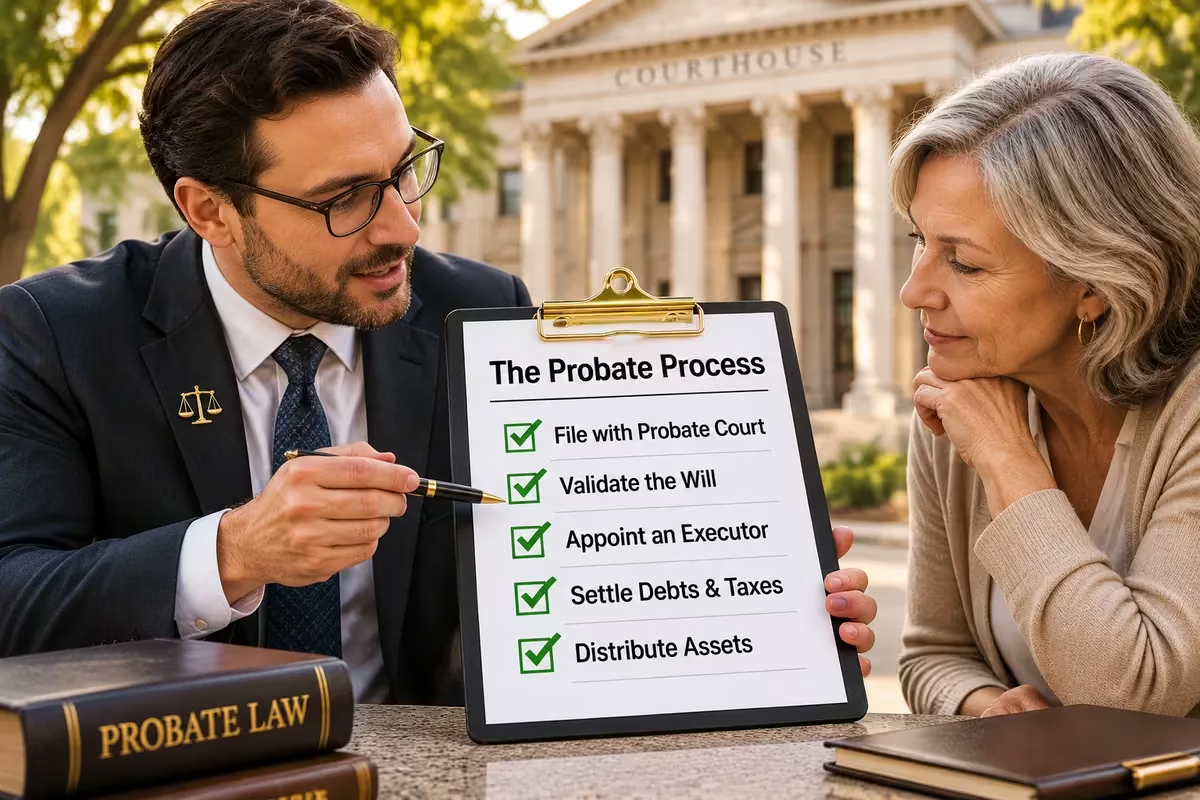
Think of probate as the legal process of settling someone’s financial affairs after death.
When a person passes away, their property doesn’t automatically transfer to their children, spouse, or other family members just because those people are named in a will.
Some assets transfer directly to beneficiaries, while others may need to go through a court-supervised process.
The property and financial interests left behind are generally called the person’s estate.
Depending on the situation, probate may involve:
- Identifying the deceased person’s assets.
- Reviewing and admitting a valid will to probate.
- Appointing an executor or personal representative.
- Notifying creditors and beneficiaries.
- Reviewing and paying valid debts.
- Handling required tax and financial filings.
- Distributing remaining probate property.
The court’s involvement helps establish who has the authority to manage the estate and ensures that the required legal procedures are followed.
For example, imagine your father owned a house entirely in his name and left a will stating that you should inherit it.
You may be the intended beneficiary, but the property might still need to go through probate before legal ownership can be transferred.
The exact requirements depend on your state and how the property was owned.
The Cornell Legal Information Institute’s explanation of probate is a useful starting point if you want to understand the legal meaning.
What Is a Probate Lawyer?
A probate lawyer is an attorney who helps individuals and families deal with the legal process of settling someone’s estate after death.
You may also hear the terms probate attorney or estate attorney.
These lawyers understand the legal paperwork, court procedures, deadlines, and state-specific rules involved in estate administration.
Their clients may include:
- Executors named in a will.
- Court-appointed administrators.
- Personal representatives.
- Beneficiaries who need legal guidance.
- Family members involved in inheritance disputes.
A probate lawyer can help you understand your responsibilities, prepare legal documents, communicate with the court, and deal with complications that may arise during the process.
One important distinction: the probate lawyer and executor are not necessarily the same person.
The executor is generally responsible for administering the estate. The lawyer provides legal representation and guidance. A lawyer may serve in another estate role if properly appointed, but hiring one does not automatically make that lawyer the executor.
Probate Lawyer vs. Estate Planning Lawyer
These two types of attorneys work in related areas, but their main responsibilities are different.
| Probate lawyer | Estate planning lawyer |
|---|---|
| Helps settle an estate after someone dies | Helps people plan for their future |
| Assists executors and administrators | Helps clients prepare wills and trusts |
| Handles probate court paperwork | Drafts estate planning documents |
| Helps address estate disputes | Helps plan asset transfers |
| Guides the distribution of estate property | Helps structure how assets may pass after death |
Some attorneys handle both areas.
If you’re preparing a will while you’re still alive, an estate planning attorney may be the better starting point. If you’re already dealing with a deceased family member’s estate, a probate lawyer may be more relevant.
What Does a Probate Lawyer Do?
This is where hiring an attorney can make a real difference.
The exact responsibilities depend on the estate, your state’s requirements, and the services you’ve agreed to pay for.
Here are the main ways a probate lawyer can help.
1. Prepare and File Probate Documents
Opening a probate case often requires specific court forms and supporting documents.
A lawyer can help prepare the petition, submit the necessary paperwork, and explain what the court expects.
Missing information or filing documents incorrectly can cause unnecessary delays.
2. Help Appoint an Executor or Administrator
If the deceased person left a valid will, it may name an executor.
The probate lawyer can help that person understand the appointment process and their responsibilities.
If there is no will, the lawyer may help an eligible family member apply to become the estate administrator.
The court makes the appointment according to applicable state law.
3. Identify and Value Estate Assets
Before property can be distributed, the estate’s assets generally need to be identified.
These may include:
- Real estate.
- Bank accounts.
- Stocks and investments.
- Vehicles.
- Business interests.
- Valuable personal property.
A probate lawyer can help organize the inventory, arrange appraisals where needed, and address ownership questions.
4. Handle Creditor Claims and Outstanding Debts
A deceased person may leave behind credit card balances, medical bills, loans, or other financial obligations.
A probate attorney can explain the required creditor-notification procedures and help the personal representative handle claims.
Remember, family members do not automatically become personally responsible for every debt their loved one leaves behind.
The Consumer Financial Protection Bureau explains that debts are generally handled through the deceased person’s estate, subject to exceptions such as co-signed obligations and certain state-law responsibilities.
Read the CFPB’s guide to debts after someone dies.
If you are also working through debts of your own, our guide on how to pay off debt walks through the main payoff methods.
5. Assist With Tax and Financial Matters
An estate may have tax-related responsibilities.
A probate lawyer can identify legal issues and coordinate with a qualified accountant or tax professional when necessary.
However, not every probate attorney prepares tax returns personally. Ask whether tax preparation is included or whether you’ll need a separate CPA.
6. Resolve Family Disputes and Will Challenges
Unfortunately, inheritance disagreements are not unusual.
Family members may disagree about the validity of a will, ownership of property, or how assets should be distributed.
A probate lawyer may represent an executor, beneficiary, or another interested party in resolving these disputes.
If a will is challenged because of alleged fraud, undue influence, or lack of legal capacity, the situation can become much more complicated.
This is one of the situations where professional legal representation can be particularly valuable.
7. Help Distribute the Remaining Property
After the necessary obligations are addressed, the remaining probate property can be distributed according to the will or applicable intestacy laws.
A probate lawyer can help prepare the necessary documents and guide the personal representative through the final stages.
You can read more about the responsibilities of probate attorneys in FindLaw’s guide.
How Much Does a Probate Lawyer Cost?

Let’s talk about the question many families want answered before they hire anyone.
Probate lawyer cost varies depending on the state, attorney’s experience, estate complexity, and the amount of legal work required. There is no single nationwide fee that applies to every probate case.
Some lawyers charge by the hour. Others offer a flat fee or use a percentage-based arrangement where permitted by applicable law.
Here is how the common arrangements work.
1. Hourly Attorney Fees
With an hourly arrangement, the lawyer charges for the time spent working on your case.
You may be billed for:
- Reviewing legal documents.
- Preparing court filings.
- Communicating with beneficiaries.
- Attending hearings.
- Handling creditor or property issues.
- Advising the executor.
Some attorneys also charge different hourly rates for lawyers, paralegals, and other staff members.
Ask for those rates before signing an agreement.
2. Flat-Fee Arrangements
Some attorneys offer a fixed price for specific probate services.
For example, a lawyer might agree to handle a relatively straightforward probate matter for an agreed fee.
However, check exactly what the flat fee includes.
Will it cover court filings? Will it include hearings? What happens if a beneficiary challenges the will?
A flat fee is only useful if you understand what falls outside the agreement.
3. Percentage-Based Fees
In some states, probate attorney compensation may be calculated using a percentage of the estate’s value.
California is one example where statutory compensation rules apply to ordinary attorney fees in many formal probate matters. Under Probate Code section 10810, the fee for the attorney’s ordinary services is 4% of the first $100,000 of the estate, 3% of the next $100,000, 2% of the next $800,000, 1% of the next $9 million and 0.5% of the next $15 million, with the court setting a reasonable amount above $25 million. The estate value is based on the inventory appraisal plus gains and receipts, without subtracting mortgages or other debts on the property. Section 10800 sets the same schedule for the executor or personal representative.
This does not mean every state follows California’s approach.
Extraordinary legal work, court approval requirements, and other state-specific rules can also affect the final amount.
What Other Probate Expenses Should You Expect?
Your lawyer’s fee is not necessarily the only expense.
Depending on the estate, you may also encounter:
- Probate court filing fees.
- Property appraisal expenses.
- Publication and notification costs.
- Executor or personal representative compensation.
- Bond premiums, if required.
- Accounting and tax preparation expenses.
- Additional legal expenses if disputes arise.
For example, the California Courts’ formal probate guide explains that court fees, appraisal expenses, and estate administration fees can add to the overall cost.
The Alaska Court System also explains that there is no standard fee arrangement for a probate, although charging by the hour is the most common and encourages families to compare estimates.
See its official probate lawyer fee guidance.
Who Pays the Probate Lawyer?
This is another question worth asking before you hire an attorney.
In many probate matters, reasonable legal fees for estate administration may be paid from estate assets, subject to state law, the fee agreement, and any required court approval.
However, don’t assume that every legal bill will automatically be paid by the estate.
The person signing the engagement agreement may have payment obligations, and disputed or unnecessary expenses may be treated differently.
Ask the lawyer to explain who is responsible for payment, whether a retainer is required, and when the estate can reimburse legal expenses.
How to Keep Probate Legal Costs Under Control
You don’t need to accept the first fee proposal you receive.
A few practical steps can help:
- Request written estimates from more than one attorney.
- Ask whether hourly, flat-fee, or another arrangement is available.
- Find out which services are included.
- Ask about additional court and administration expenses.
- Keep your documents organized before the first meeting.
- Ask whether limited legal services are available if you can handle some tasks yourself.
The Alaska Court System describes these limited services as unbundled legal services. They may be useful when someone needs help with only certain parts of the probate process.
Do You Really Need a Probate Lawyer?
Not necessarily.
Some relatively straightforward estates can be handled without hiring an attorney, depending on state law and court requirements.
However, some courts or specific probate situations require legal representation.
You should strongly consider speaking with a probate lawyer if:
- The estate includes valuable real estate.
- Family members disagree about inheritance.
- Someone is challenging the will.
- There are complicated creditor claims.
- The deceased person owned property in multiple states.
- The executor lives far away.
- The estate has complicated tax or business interests.
- You are unsure about your legal responsibilities.
For a small, uncomplicated estate, a state may offer a simplified probate or small-estate procedure.
The Texas State Law Library, for example, explains that Texas has several probate methods and that smaller estates may qualify for less formal procedures. One example is the small estate affidavit under Chapter 205 of the Texas Estates Code. It is available when the person died without a will, at least 30 days have passed since the death, no personal representative has been applied for or appointed, and the estate’s assets, not counting the homestead and exempt property, are worth no more than $75,000. A judge must approve the affidavit.
See its Texas Probate Law guide.
Before hiring an attorney, check your local court’s requirements. A short consultation may be enough to help you understand whether full legal representation is necessary.
How to Choose the Right Probate Lawyer

Choosing an attorney isn’t just about finding the cheapest quote.
You’re trusting someone to help your family handle important legal and financial responsibilities.
Here are some questions worth asking before making a decision:
Do you regularly handle probate cases?
Look for an attorney with experience in probate and estate administration in your state.
Have you handled estates similar to this one?
An estate involving a family home and a few bank accounts may require different work from one involving a business, several properties, or inheritance disputes.
How do you charge for your services?
Ask for a clear explanation of the fee arrangement and any possible additional expenses.
Who will actually work on the case?
Find out whether the attorney will handle the work personally or delegate tasks to associates and paralegals.
How will you keep the family informed?
Regular communication matters, especially when multiple beneficiaries are waiting for updates.
Can you provide a written engagement agreement?
You should understand the scope of work, payment terms, and responsibilities before moving forward.
You can also use your state’s bar association or official lawyer referral service to find attorneys licensed in the relevant jurisdiction.
How Long Does Probate Take in the US?
There is no single timeline for every US probate case.
A relatively simple estate may be settled in several months, while complicated cases can take a year or longer.
Factors that affect the timeline include:
- The state where probate is filed.
- The estate’s size and complexity.
- Creditor-notification periods.
- Property valuation and transfer issues.
- Family disagreements.
- Will contests and court hearings.
- Required tax filings.
For example, the Alaska Court System explains that many probate cases in that state take usually take between six months and a year, and often longer.
That estimate should not be treated as a nationwide deadline.
If you’re managing an actual estate, the local probate court’s rules are the best starting point.
What Happens If Someone Dies Without a Will?

When someone dies without a valid will, the legal term is intestate.
This doesn’t mean their family automatically loses the right to inherit.
Instead, state intestacy laws determine who receives the deceased person’s probate property.
Depending on the state and surviving relatives, the heirs may include:
- A spouse.
- Children.
- Parents.
- Siblings.
- Other relatives identified under state law.
The court may also appoint an administrator to manage the estate.
The distribution rules can be very different from one state to another, so never assume that the same inheritance rules apply across the entire country.
You can review the New York Courts’ guide to what happens when there is no will for an example of state-specific rules.
Can You Avoid Probate?

In some situations, yes.
Estate planning can help certain assets pass directly to beneficiaries without going through full probate.
Common arrangements include:
- Joint ownership with survivorship rights: Eligible property may pass automatically to the surviving owner.
- Life insurance beneficiaries: Policy proceeds generally pass to the named beneficiary.
- Retirement account beneficiaries: Eligible accounts can transfer directly to designated recipients (see our guide to retirement planning in your 20s).
- Payable-on-death accounts: Certain bank accounts can pass directly to named beneficiaries.
- Transfer-on-death arrangements: Available for certain assets under applicable state law.
- Revocable living trusts: Properly funded trusts can allow assets to pass according to trust terms without ordinary probate. For how that compares with a will, and when people use both, see our guide to the differences between a will and a trust.
One important point: creating a trust isn’t enough by itself. Assets generally need to be properly transferred into it.
Also, avoiding probate doesn’t necessarily eliminate all estate administration, creditor obligations, or tax responsibilities.
If you’re planning ahead, consider speaking with an estate planning attorney about which arrangements make sense for your family.
Frequently Asked Questions About Probate
What is probate in simple words?
Probate is the legal process of settling certain financial and property matters after someone dies. It can involve validating a will, appointing an executor, handling debts, and distributing remaining property.
What is a probate lawyer?
A probate lawyer is an attorney who helps families, executors, and personal representatives handle the legal requirements of settling a deceased person’s estate.
What does a probate lawyer do?
A probate lawyer can prepare court documents, advise executors, help identify estate assets, address creditor claims, assist with inheritance disputes, and guide the legal distribution of property.
How much does a probate lawyer cost?
Probate lawyer cost depends on the state, attorney’s experience, and complexity of the estate. Lawyers may charge hourly fees, flat fees, or percentage-based fees where permitted by law.
Do I need a lawyer to go through probate?
Not always. Some states allow individuals to handle straightforward probate matters themselves or use simplified procedures. However, certain courts and complicated cases may require or strongly benefit from legal representation.
Can probate happen without a will?
Yes. When someone dies without a valid will, state intestacy laws determine who inherits their probate property. A court may appoint an administrator to handle the estate.
Who pays probate lawyer fees?
Legal fees may be paid from estate assets when allowed by state law and the applicable fee arrangement. The person who hires the lawyer may also have payment obligations under the engagement agreement.
Does every estate go through probate?
No. Some assets transfer directly to beneficiaries through survivorship rights, beneficiary designations, payable-on-death arrangements, or properly funded trusts. Small-estate procedures may also be available.
How long does probate take?
It depends on the state and the complexity of the estate. Some matters take several months, while contested or complicated cases can take considerably longer.
Final Thoughts: What I Want You to Remember About Probate
If you’ve made it this far, I hope probate feels a little less intimidating than it did when you first started searching.
Here’s what I want you to take away from this guide.
You don’t automatically need an expensive lawyer just because someone in your family has passed away. You also shouldn’t assume that you can handle everything yourself without checking the rules in your state.
The right decision depends on the estate, the property involved, and whether there are any complications.
If the situation is straightforward, start by checking your local probate court’s guidance. If there’s valuable property, a disagreement over inheritance, complicated debts, or uncertainty about your responsibilities, speaking with an experienced probate attorney is a sensible step.
And if you’re reading this because you’ve recently lost someone, please don’t feel that you have to solve everything immediately. Take your time, gather the important documents, and ask questions before signing anything or making financial decisions.
At MoneyPulsar, I believe understanding money isn’t just about investing more or saving for retirement. It’s also about knowing how to protect your family, handle difficult financial situations, and make informed decisions when life doesn’t go according to plan.
That’s why I wanted this guide to explain probate in plain English rather than make another complicated legal topic harder to understand.
Take things one step at a time. Your family deserves clarity, not more confusion.
Important Disclaimer
This article is for general educational purposes only. It does not constitute legal, tax, or financial advice. Probate procedures, attorney requirements, inheritance rules, and legal fees vary by state and individual circumstances. Always verify current requirements with the relevant state probate court and consult a qualified US probate attorney about your specific situation.
Sources and Further Reading
- Cornell Legal Information Institute – Probate
- Minnesota Judicial Branch – Probate, Wills and Estates
- Texas State Law Library – Probate Law
- Alaska Court System – Finding a Probate Lawyer and Understanding Fees
- California Courts – Formal Probate and Costs
- Consumer Financial Protection Bureau – Debts After Death
- FindLaw – What Is a Probate Lawyer?
- California Probate Code § 10810 (attorney compensation)
- California Probate Code § 10800 (personal representative compensation)
- Texas Estates Code, Chapter 205 (small estate affidavit)
- Alaska Court System – Probate Background
About the Author
Syed Hamza Hasnain, Founder and Editor. He holds a BBA in Finance, has experience managing his own personal businesses, and has personal experience spot trading cryptocurrency on Binance (his own experience, not a recommendation or crypto advice). He is not a licensed financial adviser. Read more about MoneyPulsar, how we research and review content in our Editorial Policy, and our Financial Disclaimer.

Syed Hamza Hasnain · Founder & Editor
Syed Hamza Hasnain is the Founder and Editor of MoneyPulsar. He researches and edits practical guides on budgeting, debt payoff, index investing, and retirement planning across our US and Pakistan tracks using primary regulatory sources. Learn more about our editorial process →