
“A family’s future is built not only by what you earn, but by what you plan, protect, and pass on.”
If you are an overseas Pakistani living in the UK, USA, UAE, Saudi Arabia, Canada or anywhere else abroad, a Roshan Digital Account may help with the one thing you probably think about regularly: your family back home.
You send money to your parents, help your siblings, pay bills, and perhaps dream of buying a house or building something for your children in Pakistan.
But what if you could do more than simply send money?
What if you could save, invest and manage your Pakistani finances without booking a flight or asking someone to visit a bank branch on your behalf?
That is exactly where the Roshan Digital Account comes in.
What Is a Roshan Digital Account? (Quick Answer)
A Roshan Digital Account (RDA) is a bank account offered by participating Pakistani banks under a State Bank of Pakistan (SBP) initiative for overseas Pakistanis. You can open it online, receive funds from abroad, manage payments in Pakistan, and access local savings and investment options without physically visiting a branch.
Aap ghar baithe Pakistan mein investment kar sakte hain.
Let’s understand how this account works, what you can do with it, and whether it makes sense for your family’s financial future.
Table of Contents
The Main Benefits of Roshan Digital Account
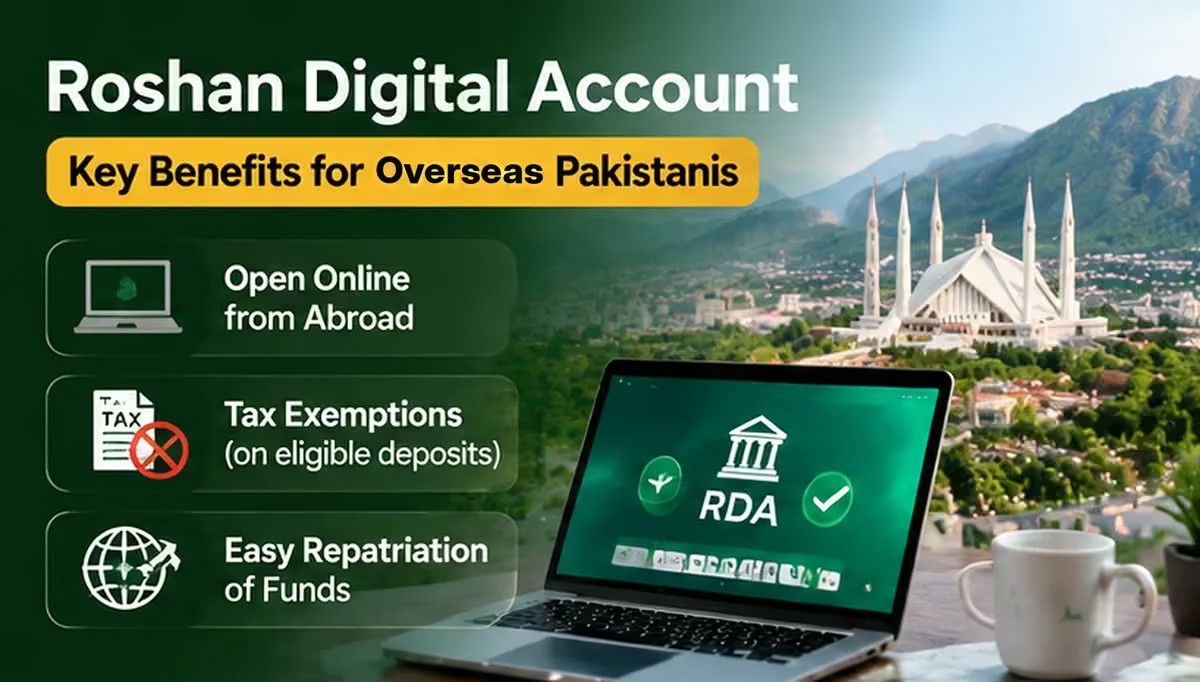
The biggest advantage of RDA is that it connects your earnings abroad with financial opportunities in Pakistan.
Previously, investing in Pakistan from overseas could involve paperwork, repeated bank visits, complicated transfers and depending on relatives to handle financial matters.
The roshan digital account benefits go beyond convenient banking. It gives eligible overseas Pakistanis a formal way to manage money and access different investment options.
Here are the benefits worth understanding.
1. Open Your Account Without Visiting Pakistan
This is probably the biggest attraction.
You do not need to travel to Pakistan, visit a bank branch or send someone to complete the account-opening process on your behalf.
You can:
- Choose a participating Pakistani bank.
- Complete the application online.
- Upload your identification documents.
- Provide proof of your overseas residence and income.
- Complete the bank’s verification process.
Once approved, you can access your account through the bank’s digital banking services.
For someone living thousands of kilometres away, this saves considerable time and effort.
According to the State Bank of Pakistan, eligible individual applications can generally be processed within two working days once the required information and documents are correctly submitted.
2. Attractive Tax Treatment
Tax is one area where RDA offers meaningful advantages, but you need to understand the difference between account deposits and investment income.
Under the SBP’s published RDA tax framework:
- Profit earned on eligible RDA deposits is tax-exempt for eligible NRPs.
- No withholding tax is deducted on profit from these RDA deposits.
- No FBR exemption certificate is required for this treatment.
- No withholding tax applies to eligible cash withdrawals or account-to-account transfers by NRPs.
- NPC profits are subject to a separate 10% final tax.
- Shares and mutual fund investments have their own tax treatment.
This is important because opening an RDA does not automatically make every investment tax-free.
We will explain the investment-specific tax rules in more detail below.
You can read the official SBP Roshan Digital Account tax FAQs.
3. Easy Repatriation of Your Money
Let’s say you transfer $10,000 from Dubai or London into your Pakistani RDA.
A few months later, you decide that you need the money back abroad.
Under the RDA framework, funds available in your account can generally be transferred back overseas without prior approval from your bank or the State Bank of Pakistan.
This is known as repatriation.
It is a particularly useful feature because your money is not permanently locked inside Pakistan simply because you transferred it here.
However, there is an important exception for real estate investments.
If you sell a property purchased through RDA before completing three years from the investment date, the original principal can be repatriated, but the capital gain generally cannot be repatriated until the three-year period is completed.
For purchases made through instalments, the date of the final instalment is used to determine the investment date.
This distinction matters if you plan to purchase Zameen in Pakistan and later sell it.
4. Access to Pakistani Banking Services From Abroad
An RDA is not simply an investment account.
Depending on your bank and account type, you can also:
- Transfer money to local Pakistani bank accounts.
- Pay electricity, gas and other utility bills.
- Pay educational fees.
- Make legitimate payments to your family.
- Access digital banking facilities.
- Request eligible debit cards and cheque books.
- Manage your account without regularly visiting a branch.
It can make managing your family’s everyday expenses much easier.
5. Conventional and Islamic Banking Options
Not everyone has the same financial preferences.
Some overseas Pakistanis prefer conventional banking, while others specifically want Shariah-compliant financial products.
RDA participating banks offer conventional and Islamic account options, subject to their individual product offerings.
For example, Meezan offers Shariah-compliant investment options, including Islamic Naya Pakistan Certificates and eligible Islamic investment products.
This gives you more flexibility when deciding how to manage Aap ka paisa.
How to Open a Roshan Digital Account (Step-by-Step)
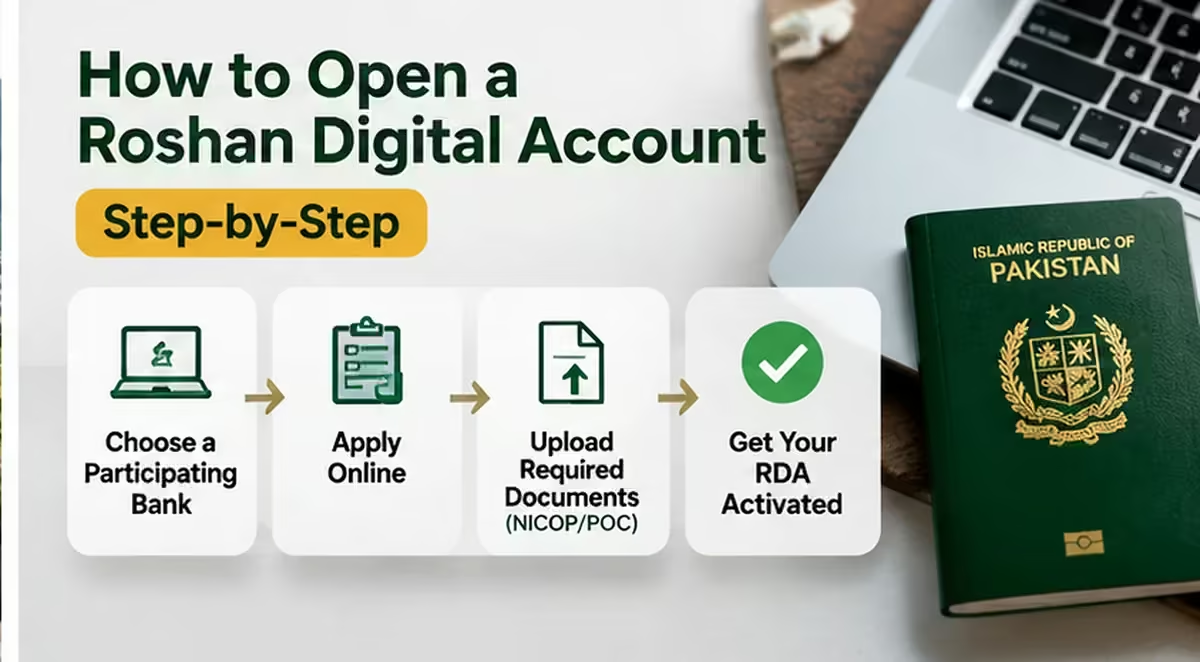
Opening an RDA is relatively straightforward.
You can complete the process online, provided you meet the eligibility requirements and have the necessary documents.
Here is how it works.
Step 1: Check Your Eligibility
The facility is primarily designed for Non-Resident Pakistanis (NRPs), including eligible overseas Pakistanis holding:
- NICOP (National Identity Card for Overseas Pakistanis).
- POC (Pakistan Origin Card).
- CNIC, where applicable.
You may also need to provide a valid Pakistani or foreign passport.
SBP’s framework also covers certain other eligible non-resident individuals and entities.
For this guide, we are focusing on individual overseas Pakistanis.
One important point: simply having a foreign address or bank account does not automatically establish your non-resident tax status. Your eligibility must be assessed under the applicable rules.
Step 2: Choose Your Pakistani Bank
The next step is selecting a bank that offers RDA services.
Some participating banks include:
- HBL (Habib Bank Limited)
- Meezan Bank
- Standard Chartered Pakistan
- UBL
- Bank Alfalah
- MCB Bank
- Allied Bank
- Faysal Bank
Other banks on SBP’s list include Bank Al Habib, Bank of Punjab, Dubai Islamic Bank, HabibMetro, JS Bank and Samba Bank. The list can change, so check SBP’s current list of RDA banks before applying.
You do not necessarily have to choose the bank your family currently uses.
Compare the account features, digital banking services, charges and investment options before making your decision.
We will compare three popular options later in this article.
Step 3: Select Your Account Type
Under the RDA framework, there are two main account categories.
Foreign Currency Value Account (FCVA)
This account allows eligible customers to maintain their money in supported foreign currencies.
Depending on the bank, currencies can include:
- US Dollar (USD)
- British Pound (GBP)
- Euro (EUR)
- Saudi Riyal (SAR)
- UAE Dirham (AED)
- Other supported foreign currencies.
This can be useful if you earn abroad and want to maintain foreign currency savings.
NRP Rupee Value Account (NRVA)
This account allows you to hold Pakistani Rupees.
It is useful if your main objective is to pay expenses in Pakistan or invest in eligible rupee-denominated products.
You can also consider whether you want a current or savings account and whether you prefer conventional or Islamic banking.
The availability of particular currencies and account variants depends on your chosen bank.
Step 4: Prepare Your Required Documents
Before starting your application, keep your documents ready.
The standard documentation requested under SBP’s RDA framework includes:
| Document | Why It Is Required |
|---|---|
| CNIC/NICOP/POC | Identity verification |
| Pakistani or foreign passport | Additional identity verification |
| Proof of non-resident status | Confirms overseas residency status |
| Employment letter or salary slip | Verifies profession and income |
| Bank statement | Helps establish source of funds |
| Business registration documents | For self-employed applicants, where applicable |
| FATCA forms | Applicable to customers in the USA |
| Recent photograph | Digital identification |
Your bank may request additional information depending on your employment, residence country, source of income and risk profile.
For example, if you work in Saudi Arabia, your employer documentation or Iqama may help establish your employment and overseas status.
If you are self-employed in the UK, business registration documents and bank statements may be relevant.
The important thing is to provide accurate information.
Step 5: Complete the Online Application
Visit your selected bank’s official website and find its Roshan Digital Account application page.
Complete the online form with:
- Your personal information.
- NICOP/CNIC or POC details.
- Passport information.
- Overseas residential address.
- Employment details.
- Source of income.
- Preferred account type and currency.
Upload the requested documents and complete the bank’s digital verification process, including any live photograph or signature requirements.
Take your time when entering your information. Small mistakes in passport numbers, addresses or document details can delay approval.
Step 6: Wait for Account Approval
After submitting your application, the bank will review your documents and complete its verification checks.
SBP’s published guidance states that an individual account should generally be opened within two working days after successful submission of the completed application and correct documents.
If the bank needs clarification, it may contact you.
Step 7: Transfer Funds From Abroad
Once your account is activated, you can transfer money through banking channels from your country of residence.
You can then use your account for eligible payments, savings and investment activities.
Important: RDA accounts are designed to receive funds from abroad. You generally cannot deposit locally generated money into an RDA, except for eligible investment returns and disinvestment proceeds.
This restriction helps maintain the account’s repatriable status.
What Can You Invest In? (The Real Opportunity)

Now comes the interesting part.
An RDA is not an investment product by itself. Think of it as a financial gateway that gives eligible overseas Pakistanis access to several investment opportunities in Pakistan.
You can potentially use it to build savings, earn investment income, participate in the stock market or purchase property.
Let’s look at the main options.
1. Naya Pakistan Certificates (NPCs)
If you are an overseas Pakistani looking for a government-issued investment option, Naya Pakistan Certificates deserve your attention.
These are sovereign investment instruments issued by the Government of Pakistan and administered through the State Bank of Pakistan.
They are available in different currencies and investment periods.
You can generally choose maturities of:
- 3 months
- 6 months
- 12 months
- 3 years
- 5 years
The two options that many overseas Pakistanis compare are USD and PKR certificates.
USD Naya Pakistan Certificates
Suppose you earn in US dollars and want to invest without converting your money into Pakistani Rupees.
A USD-denominated NPC allows you to invest in a dollar-based certificate.
Potential advantages include:
- Your investment is denominated in USD.
- You avoid directly taking PKR-to-USD exchange-rate risk on the principal.
- You can select from different maturity periods.
- You receive returns according to the applicable certificate terms.
This may make sense if your future financial commitments are also in US dollars.
PKR Naya Pakistan Certificates
Now suppose your objective is different.
You want to build a house in Lahore, purchase property in Islamabad or support your parents with regular expenses.
In that situation, a PKR-denominated investment may be worth considering.
PKR certificates generally offer different annualized returns from foreign currency certificates.
However, do not make your decision based only on the headline profit rate.
If the Pakistani Rupee depreciates significantly against the US Dollar, your investment’s dollar-equivalent value may fall even if you earn a higher nominal return in PKR.
For example, if the Rupee loses more value against your home currency in a year than your PKR investment earns, your return measured in that currency could be negative even before other costs.
The right choice depends on the currency in which you expect to spend your money.
Are Naya Pakistan Certificates Halal?
There are both conventional and Islamic Naya Pakistan Certificates.
Islamic NPCs operate under a Mudarabah structure, using funds in Shariah-compliant investment pools.
Their actual profit is calculated according to the applicable Islamic structure and pool performance.
If avoiding Riba is important to you, look specifically for Islamic Naya Pakistan Certificates rather than assuming every NPC is Shariah-compliant.
Also remember that Shariah compliance and investment safety are two different considerations. An Islamic investment is not automatically free from financial or sovereign risk.
What About Tax on NPCs?
According to SBP’s published RDA tax guidance, profit earned on Naya Pakistan Certificates is subject to a 10% withholding tax.
This is treated as full and final tax on the certificate profit, with no separate Pakistani tax return filing required for that profit under the stated regime.
NPC rates, currency availability and terms can change. Check the official SBP NPC information before investing.
2. Pakistani Stock Market (PSX)
Have you ever wanted to invest in Pakistani companies while living overseas?
For example, perhaps you want exposure to established Pakistani businesses, banks, energy companies or other listed companies.
Through RDA, eligible overseas Pakistanis can invest in the Pakistan Stock Exchange (PSX).
This facility operates through a special arrangement called the Roshan Equity Investment Account (REI).
Here is how it works.
Step 1: Open your RDA with a participating bank.
Step 2: Log in to your bank’s online portal or mobile app.
Step 3: Select the Roshan Equity Investment option.
Step 4: Provide consent for sharing the required information with the Central Depository Company (CDC) and relevant capital market entities.
Step 5: Accept the terms and conditions for investing in Pakistan’s capital market, then select an eligible brokerage firm.
Step 6: Complete the account-opening process and transfer funds to your designated investment account.
Once the arrangements are completed, you can use your broker’s trading platform to buy and sell eligible securities.
The process also involves the creation of your investor identification and custody arrangements through the relevant market institutions.
You do not need to travel to Pakistan just to place your stock market investments.
Is Investing in PSX Risk-Free?
Absolutely not.
Stock prices can rise and fall depending on company performance, economic conditions, interest rates, political developments and investor sentiment.
You should:
- Research a company before purchasing its shares.
- Avoid investing money you may need immediately.
- Diversify instead of putting everything into one company.
- Understand brokerage fees and other transaction costs.
- Consider your investment horizon.
If you are new to investing, read our Best Investment in Pakistan guide before putting your savings into the stock market.
3. Mutual Funds
Another option worth exploring is mutual funds.
Instead of selecting individual company shares yourself, you can invest in a professionally managed fund.
Depending on the eligible product and bank arrangements, RDA holders can access open-ended mutual funds.
These may include:
- Money market funds.
- Income funds.
- Equity funds.
- Balanced funds.
- Islamic mutual funds.
Each category has a different investment objective and risk level.
For example, money market funds generally focus on short-term instruments, while equity funds invest in shares and can experience greater price fluctuations.
If you prefer Shariah-compliant investments, you can explore Islamic mutual funds.
However, always review the fund’s offering document, management fees, risk profile, redemption terms and historical performance.
Historical returns do not guarantee future profits.
For fund types, fees and tax in more detail, read our Mutual Funds in Pakistan guide.
4. Real Estate in Pakistan
Let’s talk about something close to the heart of many overseas Pakistanis: owning property back home.
Perhaps you want to buy a house for your parents, purchase an apartment for your children or invest in land for the future.
RDA provides an eligible route for overseas Pakistanis to invest in residential and commercial real estate in Pakistan.
According to SBP’s guidance, eligible property investments through the NRP Rupee Value Account can include:
- Residential houses.
- Apartments.
- Commercial properties.
- Land.
- Properties in new housing schemes.
- Existing housing developments.
- Already constructed properties.
Purchases can be made in a lump sum or through instalments, subject to the relevant arrangements.
There are also provisions for eligible joint property investments with family members.
Why Is This Useful?
Previously, some overseas Pakistanis relied heavily on relatives or representatives to handle property transactions.
With RDA, you have a formal banking channel for transferring eligible funds towards your property investment.
You can also receive eligible rental income from property purchased through RDA into the account.
The rental income and sale proceeds from such an investment can be repatriated, subject to applicable rules.
Three Important Things Before Buying Property
First, RDA does not guarantee that a property is genuine or legally approved.
You must independently verify:
- Property ownership documents.
- Housing society approvals.
- Development authority permissions.
- Outstanding liabilities.
- Transfer and registration requirements.
Second, understand the special repatriation rules.
If you sell the property before three years, the original investment amount can generally be repatriated, but the capital gain must wait until the three-year period is completed.
Third, understand the tax implications.
Under the Income Tax Ordinance as amended by the Finance Act 2026, advance tax on property is 1.25% of the fair market value for the buyer (section 236K) and 2.75% of the gross consideration for the seller (section 236C). If you are a non-resident Pakistani with a NICOP, POC or CNIC and you buy through your RDA (FCVA or NRVA), the tax collected at purchase is your final tax on the purchase. When you later sell that property, the tax collected at sale is final in place of capital gains tax on it. FBR also says overseas Pakistanis who hold a NICOP or POC and spend less than 183 days in Pakistan in a financial year pay the filer rate on these two taxes even if they have not filed a return. SBP’s RDA FAQ still shows older 1% figures, so go by the current law. Before you sign, confirm the exact amount with your bank, the registrar or housing society and a qualified tax adviser.
Other applicable property-related costs, provincial charges and legal expenses should also be checked before completing a purchase.
Do not sign a property agreement simply because someone promises that RDA makes the entire transaction tax-free.
5. Government Securities and National Savings
Your investment choices do not end with NPCs.
Eligible RDA holders can also access certain government debt securities through the permitted account and investment arrangements.
These may include:
- Treasury Bills (T-Bills).
- Pakistan Investment Bonds (PIBs).
- Government Sukuk.
- Eligible Central Directorate of National Savings (CDNS) securities.
- Other permitted government securities.
The exact availability depends on the account category, bank and applicable investment arrangements.
If you are interested in relatively conservative savings options, it is worth understanding how these products work before making a decision.
To compare current National Savings products, see our National Savings profit rates guide.
Remember, different government securities have different maturity periods, return structures, liquidity arrangements and risks.
Which Bank Should You Choose?

This is where many overseas Pakistanis get confused.
HBL, Meezan and Standard Chartered all offer Roshan Digital Account services, but their product features and digital experiences are not identical.
There is no single bank that is automatically the best choice for everyone.
Your decision should depend on how you plan to use the account.
Let’s compare three popular options.
1. Meezan Bank
If Islamic banking is your priority, Meezan deserves a close look.
Meezan offers a Shariah-compliant Roshan Digital Account with access to several Islamic investment options.
Its published RDA features include:
- Digital account opening.
- PKR and supported foreign currency accounts.
- Islamic Naya Pakistan Certificates.
- Eligible Shariah-compliant PSX investments.
- Islamic mutual fund investment options through Al Meezan.
- Internet banking.
- A dedicated relationship management team.
Its mobile banking app also provides account management, transfers and bill payments.
Who should consider Meezan?
Overseas Pakistanis who specifically want an Islamic banking relationship and convenient access to Shariah-compliant investments.
Official website: Meezan Bank Roshan Digital Account
2. HBL (Habib Bank Limited)
HBL is another established option for overseas Pakistanis.
Its RDA offering provides access to banking services and eligible investment facilities.
HBL’s published digital banking information highlights features such as:
- RDA account management.
- Naya Pakistan Certificate requests.
- CDC investment-related services.
- Local fund transfers.
- Repatriation-related services.
- WhatsApp banking and customer assistance.
HBL also publishes account-specific schedules of charges, so it is worth checking the latest fees before applying.
Who should consider HBL?
People who want to explore an established banking network and use digital services for both everyday transactions and investment activities.
Official website: HBL eBanc Roshan Digital Account
3. Standard Chartered Pakistan
Standard Chartered offers Roshan Digital Account facilities for eligible overseas customers.
Its published account information highlights:
- Multiple currency options.
- Conventional banking.
- Saadiq Islamic banking options.
- Online banking.
- SC Mobile access.
- Current and savings account options, depending on the selected product.
Two important points from Standard Chartered’s RDA FAQs. First, because of cross-border restrictions, it may not offer an RDA or NPC investment to residents of some countries. Second, it says it does not offer real estate, equity, mutual fund or other government securities products through the account, apart from NPCs and Islamic NPCs.
Therefore, check your country of residence before applying.
Who should consider Standard Chartered?
Overseas Pakistanis who value its international banking presence and want to compare its digital banking and multi-currency facilities.
Official website: Standard Chartered Pakistan Roshan Digital Account
Bank Comparison at a Glance
| Feature | Meezan | HBL | Standard Chartered |
|---|---|---|---|
| Digital RDA opening | Yes | Yes | Yes |
| Islamic option | Yes | Yes, subject to product | Saadiq |
| Mobile banking | Meezan App | HBL Mobile | SC Mobile |
| Investment access | Islamic NPCs, PSX and mutual funds | NPCs and PSX facilities | NPCs and Islamic NPCs only |
| Customer assistance | Dedicated relationship team | WhatsApp and banking support | Online and contact-centre support |
| Multi-currency options | Yes, supported currencies | Yes, supported currencies | Yes, supported currencies |
Features are based on published bank information. Product availability, fees and eligibility can change.
How Should You Make the Final Decision?
Before opening an account, compare these five things:
- Mobile app experience: Can you easily access your account from your country? Does the app work reliably with your overseas mobile number?
- Customer service: Can you reach a representative when something goes wrong? Is there an overseas customer support channel?
- Investment access: Does the bank support the specific NPC, PSX or mutual fund investment you want?
- Bank charges: Check debit card fees, cheque book charges, foreign transfers and other applicable costs.
- Currency and exchange rates: Compare the actual exchange rates offered by banks, not just their advertised transfer facilities.
The practical rule: choose the bank that makes it easiest to manage your money from abroad, not the one with the most attractive marketing campaign.
Frequently Asked Questions About Roshan Digital Account
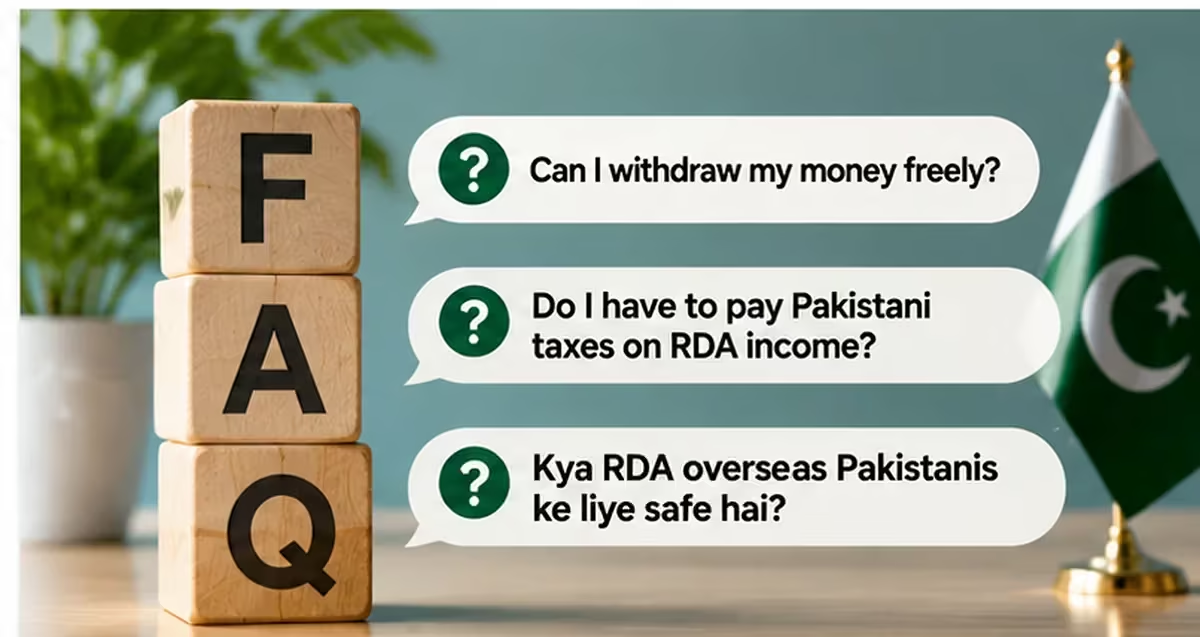
Here are answers to some of the most common questions overseas Pakistanis ask before opening an RDA.
Can I withdraw my money freely?
Yes. You can withdraw your available RDA funds in Pakistani Rupees or foreign currency in Pakistan, subject to the bank’s facilities and applicable charges. You can also repatriate eligible funds abroad without prior SBP approval, subject to the special three-year restriction on real estate capital gains.
Do I have to pay Pakistani taxes on RDA income?
Not on every type of income. Eligible RDA deposit profits are tax-exempt, while NPC profits generally attract 10% final tax and eligible share and mutual fund income has separate tax treatment under the SBP framework.
Ek sawal jo sab poochte hain: Kya RDA overseas Pakistanis ke liye safe hai?
Yes, RDA is an official banking facility operating under the State Bank of Pakistan’s regulatory framework and offered through participating banks. However, remember that the safety of your bank account and the risks of your investments are two different things; always research an investment before committing your savings.
Can I open a Roshan Digital Account without visiting Pakistan?
Yes. Eligible overseas Pakistanis can generally complete the application and verification process digitally without visiting a Pakistani bank branch or embassy, provided they satisfy the bank’s requirements.
Can I deposit money into my RDA from a Pakistani bank account?
Generally, no. RDA accounts are funded through permitted foreign remittances, although eligible profits, returns and disinvestment proceeds from RDA investments can be credited to the account.
Important Things to Remember Before Opening Your RDA
Before you transfer your hard-earned money, keep these points in mind.
1. Understand your currency exposure. If you earn in USD but invest in PKR, exchange-rate movements can affect your actual returns when measured in dollars.
2. Do not invest everything in one product. You do not need to put all your savings into NPCs, property or the stock market. Consider your goals, emergency savings and investment horizon.
3. Read the bank’s fee schedule. Even when account opening is free, certain services, cards and international transactions may carry charges.
4. Understand the difference between tax rules and residency rules. Your RDA status does not automatically determine your tax residency. Your Pakistani tax obligations depend on the applicable legal rules, and your country of residence may also have its own tax requirements.
5. Keep your investment records. Save your transfer receipts, account statements, NPC confirmations, property documents and brokerage statements. These documents can be useful when you need to verify your funds or handle tax and legal matters.
6. Never share your banking credentials. Do not share OTPs, passwords, account access or sensitive documents with unverified agents or property dealers. Use your bank’s official website and customer support channels.
Final Thoughts: Is Roshan Digital Account Worth It?
If you are an overseas Pakistani who wants to maintain a financial connection with Pakistan, the Roshan Digital Account can be a genuinely useful facility.
It removes many of the practical difficulties associated with opening a Pakistani bank account from overseas.
More importantly, it gives you access to several financial opportunities, including Naya Pakistan Certificates, the Pakistani stock market, eligible mutual funds and property investments.
But remember something.
You worked hard to earn your money abroad. You should be just as careful when deciding where to invest it back home.
Do not chase the highest advertised return. Do not buy property simply because a relative recommends it. And do not assume that every government-backed or bank-offered investment is automatically risk-free.
Start with a clear financial goal.
If your goal is to support your family, keep sufficient money available for their needs. If your goal is retirement, compare investments according to your time horizon. If you want to build long-term wealth in Pakistan, understand the risks before committing your savings.
A well-planned financial future is not about making one big investment. It is about making sensible decisions consistently.
And with the right approach, your hard-earned money can do more than just reach your Ghar walay. It can also help build a more secure future for them.
Important Financial Disclaimer
This article is for educational purposes. Always verify current SBP regulations and your chosen bank’s terms.
MoneyPulsar does not replace professional financial, legal or tax advice. Investment returns are not guaranteed, and financial products may involve currency, market, liquidity and sovereign risks. Tax treatment may change, and readers should confirm their individual obligations with a qualified tax professional.
Last checked against published SBP guidance: 2 November 2026.
Official References
- State Bank of Pakistan – Roshan Digital Account
- SBP – Roshan Digital Account FAQs and Tax Treatment
- SBP – Naya Pakistan Certificates
- Pakistan Stock Exchange – Roshan Equity Investment
- Meezan Bank – Roshan Digital Account
- HBL – Roshan Digital Account
- Standard Chartered – Roshan Digital Account
- FBR – Withholding Tax Rate Card (Finance Act 2026)
- FBR – Overseas Pakistanis FAQs
- FBR – Income Tax Ordinance, 2001 (amended up to 30 June 2026)
- Standard Chartered – FAQs on Roshan Digital Account (PDF)
- SECP – Securities and Exchange Commission of Pakistan

Syed Hamza Hasnain · Founder & Editor
Syed Hamza Hasnain is the Founder and Editor of MoneyPulsar. He researches and edits practical guides on budgeting, debt payoff, index investing, and retirement planning across our US and Pakistan tracks using primary regulatory sources. Learn more about our editorial process →