
Direct Answer: Beginners can start investing in 2026 by building a small emergency fund, capturing any 401(k) employer match, then opening a Roth IRA or brokerage account and automating a monthly buy of a low-cost, broad index fund. You can start with as little as $10, and free government resources like Investor.gov explain the basics.
If you’ve built a budget that works, the next logical step is making your money grow. If you haven’t built that foundation yet, start with our guide on 15 Budgeting Tips That Actually Work in 2026 — it takes 30 days and makes everything below easier.
But if the investing world feels like a casino where the house always wins, you’re not alone. Many beginners put off investing because it seems complicated. Here’s what they don’t know: in 2026, the barriers that kept regular people out are gone. You can start investing with as little as $10, and you can do it from your phone in about 15 minutes. This guide on how to start investing for beginners shows you exactly how.
Key Takeaways:
- You can start with $10 or less — the biggest myth about how to start investing for beginners is that you need a lot of money.
- Start with a tax-advantaged account like a Roth IRA before a regular brokerage account
- Buy a low-cost index fund — don’t try to pick individual stocks as a beginner
- Automate your contributions. The habit matters more than the amount
- 2026 offers new AI tools that make research and portfolio building easier than ever
Why Most Beginners Never Actually Start
The biggest lie about how to start investing for beginners is that you need to know something special first. If you want the mechanics first — compounding, fees and how stocks actually make money — read how investing works.
The most common reason people give for not investing is “I don’t have enough money.” In 2026, that reason no longer holds.
Fractional shares — which let you buy a slice of a $500 stock for $10 — are now standard at most major brokerages. Commission-free apps mean you don’t pay fees to buy or sell. And index funds let you own hundreds of companies at once, so you never have to pick a “winner.”
The real barrier is psychological. People wait until they have “enough” money. That day never comes. The habit of investing — even $25 a month — is what builds wealth.
The $10 Experiment (Do This Today)
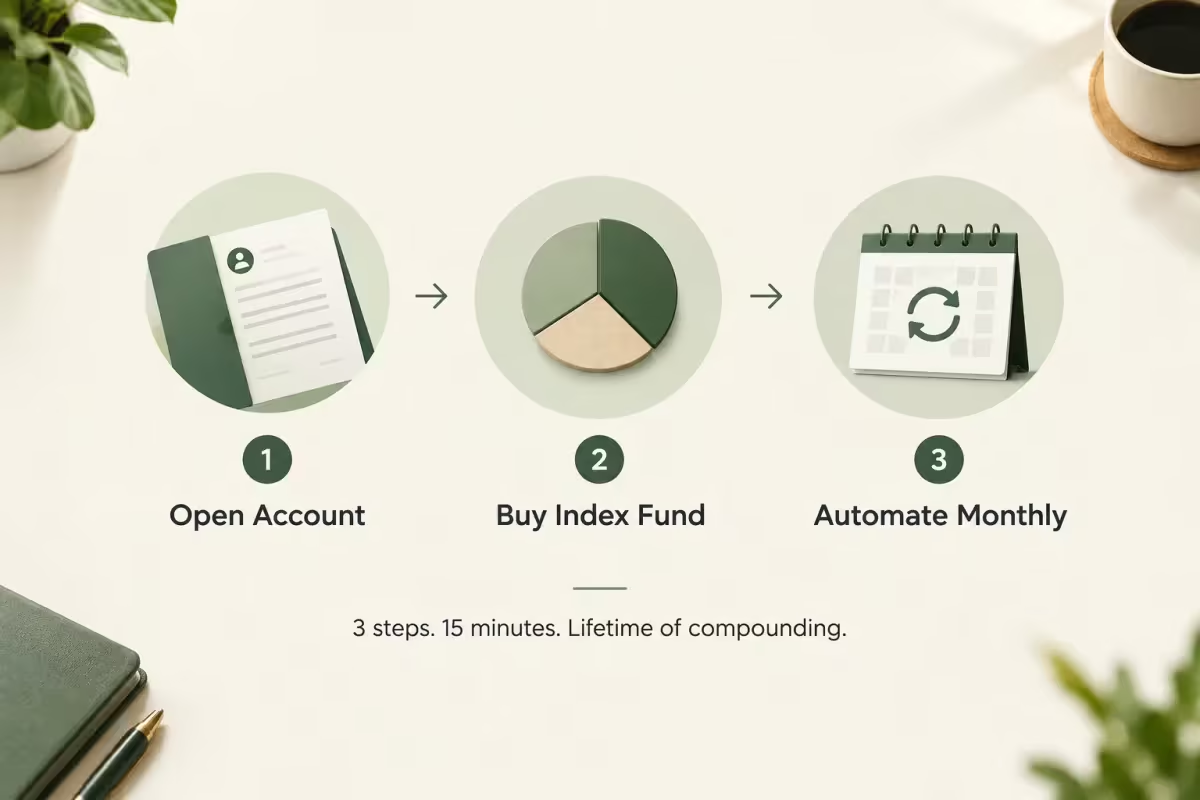
Here’s a simple test. Open a brokerage account (Fidelity, Vanguard, Schwab, or Robinhood all have zero minimums and zero commissions). Transfer $10. Buy a fractional share of an S&P 500 index fund. That’s it.
You just became an investor. The psychological shift from “I can’t” to “I did” is worth more than the $10 itself.
Step 1 — Open the Right Account (Order Matters)
Where you invest matters as much as what you buy when you’re learning how to start investing for beginners, because the account type determines your taxes. Here’s the order most experts recommend:
- 401(k) with Employer Match
If your job offers a 401(k) with matching contributions, contribute at least enough to get the full match. This is free money — an instant 50-100% return on every dollar you put in. - Roth IRA
A Roth IRA lets your money grow tax-free. You contribute after-tax dollars, and when you withdraw in retirement, you pay no taxes on the growth. Under IRS rules for 2026, eligible investors can contribute up to $7,500 per year ($8,600 if 50 or older; the IRS has confirmed both amounts stay the same for 2027), subject to income phase-outs, and qualified distributions in retirement (after age 59½ and a 5-year holding period) are tax-free. For beginners — especially those focused on retirement planning in your 20s while in a lower tax bracket — this is the best retirement account available. - Regular Brokerage Account
Once you’ve maxed out the tax-advantaged accounts, or if you’re investing for a goal before retirement (like a house down payment), open a regular taxable brokerage account. No contribution limits, no early-withdrawal penalties.
What About Fees?
Fees are the silent killer of investment returns. A 1% annual fee doesn’t sound like much, but it compounds. Example: $10,000 growing at a hypothetical 7% a year becomes about $76,123 after 30 years ($10,000 × 1.07^30). At 6% a year (the same return minus a 1% fee) it becomes about $57,435 ($10,000 × 1.06^30), roughly 25% less money.
When choosing an account, look for:
- Zero commission on stock and ETF trades
- Zero account minimum (so you can start with any amount)
- Low expense ratios on the funds you buy (index funds should be under 0.10%)
Step 2 — Choose What to Buy (Keep It Simple)
Beginners often freeze at this step of how to start investing for beginners. They think they need to research individual companies, read earnings reports, and predict the next Amazon.
You don’t. In fact, doing that usually leads to worse results than doing almost nothing.
The Boring Answer Most Fund Managers Struggle to Beat
For many beginners, one of the simplest starting points is also the most boring: a low-cost S&P 500 index fund. It’s one possible option, not the right choice for everyone. Your timeline, risk tolerance, debts and need for emergency cash all matter, and an S&P 500 fund holds only large US companies.
An S&P 500 index fund holds shares in the 500 largest U.S. companies — Apple, Microsoft, Nvidia, Amazon, and 496 others. When you buy it, you own a tiny slice of all of them. You never have to pick a winner because you own the entire market.
Why this works: According to the SPIVA U.S. Year-End 2025 Scorecard from S&P Dow Jones Indices, 92.89% of actively managed U.S. large-cap funds underperformed the S&P 500 over the 20 years ending December 31, 2025. Picking the few funds that will outperform in advance is hard. An index fund doesn’t try to beat the market; it aims to match the index’s return, minus a small fee. Past performance doesn’t guarantee future results.
The Three Funds That Cover Everything
| Fund | What It Covers | Why Beginners Like It |
| VOO or VTI | U.S. stock market (500 or 3,600+ companies) | The core of your portfolio. Low cost (0.03%) |
| VXUS | International stocks (companies outside the U.S.) | The U.S. is only ~60% of global markets |
| BND | U.S. bonds | Reduces volatility. Add 10-20% for stability |
The table above shows a classic three-fund index portfolio for broad U.S., international, and bond diversification. Once your core stock and bond index funds are automated, you can also explore how REITs and property funds work in our guide to Real Estate Investing for Beginners With Little or No Money.
Step 3 — Automate It (This Is the Most Important Step)
The single best thing you can do as a beginner investor is set up an automatic transfer.
Here’s why automation matters more than the amount: investing $250 per month for 40 years adds up to $120,000 of your own money. If it earned a hypothetical 10% a year (an effective annual rate converted to a monthly rate of 1.10^(1/12) − 1, with deposits at the end of each month), it would grow to about $1.39 million before taxes, fees and inflation. At a hypothetical 7% return, it would be about $618,000. These are illustrations, not predictions: real returns vary from year to year, can be negative, and are never guaranteed.
But the only way to get that result is to stay invested through every market crash, every scary headline. Automation removes the emotional decision-making that causes people to sell at the bottom.
How to Set It Up
In your brokerage app, find the “automatic investment” feature
- Set a fixed amount — $25, $50, $100, whatever you can sustain
- Choose the same day each month
- Select your index fund
That’s it. You’re now investing on autopilot.
Step 4 — The 2026 Upgrade: Where AI and Fintech Fit In
Here’s where this guide differs from the typical “buy index funds and wait 30 years” advice.
In 2026, a new category of AI-powered tools has emerged that makes investing research faster and more accessible for beginners.
AI Investing Tools for Beginners
Platforms like Danelfin assign AI scores to thousands of stocks based on probability of outperforming the market. TrendSpider offers automated technical analysis without requiring coding. Perplexity Finance combines multiple AI models to generate investment analysis with sources cited.
But here’s the catch: These tools are best used as learning aids and screeners, not as oracles. A general AI chatbot can explain what a P/E ratio is, but it cannot predict whether a stock will go up. Use AI to understand concepts faster, not to make decisions for you.
Where to Keep Your Emergency Fund (and Why Stablecoins Are Different)
Your emergency fund is money you may need quickly, so safety and access matter more than return. (Our guide to the types of savings accounts compares the main options.) Common places people keep it include:
- High-yield savings accounts at banks or credit unions. Rates are variable. As of November 16, 2026, the FDIC’s national average savings rate was 0.39%, while some online banks paid considerably more. Bank deposits are FDIC-insured up to $250,000 per depositor, per insured bank, per ownership category (credit unions have similar NCUA coverage).
- Short-term U.S. Treasury bills. They’re backed by the U.S. government; 13-week (3-month) bills yielded about 4.3% on November 27, 2026 (4.27% coupon-equivalent, per the Treasury daily bill rates). You can lose money if you sell before maturity and prices have moved.
What about stablecoins?
A stablecoin is a crypto token designed to hold a steady value, usually $1. It is not a bank deposit. Under the GENIUS Act (signed July 18, 2025), payment stablecoins are not backed by the U.S. government and are not covered by FDIC deposit insurance or NCUA share insurance, and stablecoin issuers are not allowed to pay holders interest or yield just for holding the coin. When a ‘stablecoin yield’ is advertised, it comes from someone other than the issuer, such as an exchange or lending platform. That adds risks: the platform can fail, pause withdrawals or change its terms, and the token itself can lose its $1 value. For these reasons, a stablecoin balance is not a like-for-like substitute for an insured savings account. This section is general education, not a recommendation to buy or hold any crypto asset.
My Personal Opinion on Beginner Investing in 2026
I think the financial industry has spent decades making investing seem harder than it is. The message has always been: “You need to be smart, you need to pick the right stocks, you need to time the market.” That message benefits the industry — it keeps people paying for advisors and expensive funds. It doesn’t benefit you.
The truth is simpler and more powerful: Buy a low-cost index fund. Automate it. Don’t touch it for 30 years. Over long periods, that simple approach has outperformed most actively managed large-cap funds, though past results don’t guarantee future returns.
I see too many beginners in 2026 getting distracted by the wrong things. They watch videos about “the next 100x crypto” and skip the basics. (If day trading or crypto is what pulled you in, our beginner’s guide to trading explains the real risks and costs.) Chasing a high advertised yield usually means taking on risks that aren’t obvious up front, so it’s worth understanding what protects your money, and what doesn’t, before you move it.
Where many beginners start: use any employer 401(k) match, consider a Roth IRA if eligible, pick a diversified low-cost index fund, and automate a small monthly amount. Once those basics are in place, some people explore newer tools, but the core habits matter more than the latest product. What fits you depends on your income, taxes, debts and timeline.
Common Beginner Investing Mistakes to Avoid
- Waiting for the “right time” to invest. Time in the market beats timing the market
- Picking individual stocks because you “have a feeling.” You don’t have an edge. Buy the index. If you still want to try short-term trading, read our guide on how to start trading first, and practice with virtual money.
- Checking your portfolio every day. The market goes up and down. Daily checks cause panic selling
- Chasing yield in risky places. If an investment promises 20% guaranteed, it’s a scam
- Ignoring fees. A 1% fee doesn’t sound like much, but it compounds against you
- Investing money you need soon. Only invest money you won’t touch for at least 5 years
Beginner Investing FAQ
How much money do I need to start investing?
You can start with $10 or even $5 in 2026. Fractional shares let you buy a slice of any stock or fund. The amount matters far less than the habit.
What’s the best investment for a beginner?
There’s no single best investment for every beginner. A low-cost, broadly diversified index fund, such as an S&P 500 or total-market fund, is a common starting point because it spreads your money across hundreds of companies and usually charges low fees. Returns vary widely from year to year, can be negative, and are never guaranteed.
Should I pay off debt before investing?
If you have high-interest debt (like credit cards at 20%+ APR), pay that off first. No investment reliably returns 20%. But if you have low-interest debt (like a mortgage at 4%), you can invest while paying it down. We cover this in detail in our guide to paying off high-interest debt, and you can test your monthly payments in our free debt payoff calculator.
What if the market crashes right after I invest?
It will, at some point. That’s normal. Since 1945, the S&P 500 has experienced 20%+ drops many times — and recovered from every one. If you’re investing for 10+ years, a crash is a buying opportunity, not a disaster.
How do I start investing for beginners with little money?
Open a zero-minimum brokerage account. Set up a recurring transfer of $10-25 per month. Buy a fractional share of an index fund. Automate it. That’s the entire process.
Where can beginners get free, trustworthy investing help?
Start with the SEC’s free Investor.gov introduction to investing. Before paying anyone for advice, look up the broker or adviser on FINRA BrokerCheck to see their registration and any disciplinary history.
The Bottom Line
Knowing how to start investing for beginners doesn’t have to be complicated. In 2026, the tools exist to start with almost any amount, from any phone, with almost no fees. The only thing standing between you and your first investment is the decision to start.
Open the account. Transfer the money. Buy the index fund. Set the automation. Then go back to living your life. That’s how wealth gets built — slowly, boringly, and almost automatically.
If you’re still building your foundation, start with our 15 Budgeting Tips That Actually Work in 2026.
Investing is one path to passive income. For more ways to earn beyond your salary, read our guide on How to Make Passive Income in 2026. If you want a low-cost way to add extra income you can invest, consider selling Notion templates.
Investing isn’t just for short-term goals. See our guide on How to Plan for Retirement in Your 20s for the long-term version of the same strategy, and our step-by-step guide on how to invest for retirement for account choices at any age. To see what a steady monthly habit could add up to by retirement age, try our free retirement calculator.
Disclaimer: This MoneyPulsar article is for general educational purposes in the United States and does not constitute personalized investment, financial, tax, or legal advice. Mentioned ETFs (VOO, VTI, VXUS, BND), brokerages, and research tools are illustrative examples, not endorsements or recommendations. All investing involves risk, including possible loss of principal. Read our full Financial Disclaimer.

Syed Hamza Hasnain
Syed Hamza is the Founder of MoneyPulsar. He researches US and Pakistani regulatory frameworks to provide plain-English financial education. About MoneyPulsar →