

Most advice about passive income is written by people selling a course about passive income. That’s the problem. You can’t trust a guide that ends with a $497 upsell.
So let’s start with the truth: passive income is real, but it is narrower, slower, and less photogenic than the version sold online. In 2026, the gap between people who actually earn money outside their job and people who just pin infographics about it comes down to one thing — whether they understand which category they’re signing up for. This guide covers how to make passive income that actually works, using real numbers, not screenshots.
Key Takeaways:
- Truly passive income (dividends, index funds) needs capital, not effort. Expect 4-8% per year.
- Semi-passive income (rentals, royalties) earns more but takes 5-20 hours a month of real work.
- AI is now the single biggest dividing line. AI users report monthly side-hustle earnings of $555 versus $333 for non-users.
- “Passive” digital products are a business with low marginal cost, not a hands-off income stream.
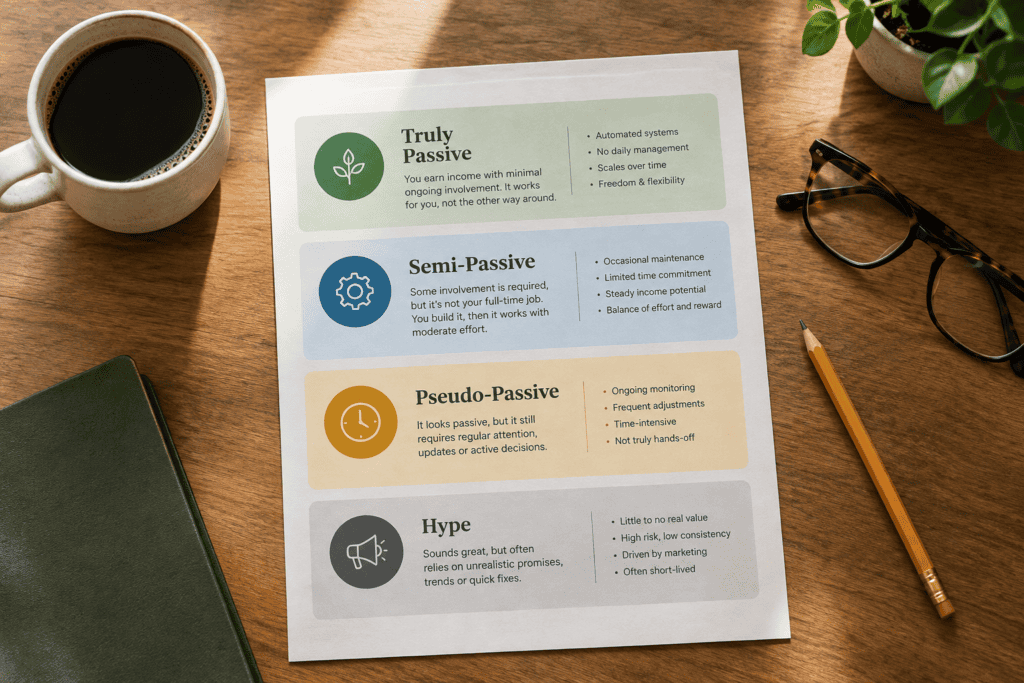
The Four Tiers of Passive Income (Sort Yours Before You Start)
Almost every income idea fits one of four buckets. The bucket determines what kind of work you’re actually signing up for — and this is where most beginners get it wrong. They chase “pseudo-passive” digital products thinking it’s the same as “truly passive” dividends, then burn out when it turns out to be a business.
Here are the four tiers, sorted honestly:
| Tier | Examples | Capital Needed | Hours/Month | Realistic Yield |
|---|---|---|---|---|
| Truly Passive | Dividends, index funds, REITs, T-bills | High | 0-1 | 4-8%/yr |
| Semi-Passive | Rentals, royalties, ad-supported video | Medium-High | 5-20 | 5-12% net |
| Pseudo-Passive | Digital products, courses, newsletters | Low | 15-40 | Highly variable |
| Hype | Dropshipping, generic affiliate blogs, AI content farms | Low-Medium | 20-60+ | Often negative |
Why this matters: If you have $500 and 10 hours a week, the “truly passive” tier is not available to you yet. A 5% yield on $500 is $25 a year. You belong in pseudo-passive or semi-passive — and that’s fine. It’s just a different job with a different timeline. The mistake is reading about dividends and expecting the same effort as selling a Notion template.
How to Make Passive Income: The Truly Passive Tier (Capital Does the Work)
This is the closest thing to honest passive income. You park money, the money earns money, and your job is mostly not panicking when the chart drops. The catch is obvious — without capital, the returns are tiny. The same yield on a larger balance becomes a livable income over time.
Dividend Stocks and Index Funds
Owning shares in profitable companies that distribute part of their earnings as dividends is the textbook definition of passive. In 2026, the S&P 500’s dividend yield sits around 1.3%. That is not a typo. If you invest $10,000 in a broad S&P 500 index fund, you’re earning about $130 a year in dividends — before taxes. That’s the honest math that almost no “passive income” article will give you.
The good news: you don’t need a 10% yield. You need consistency and time. A portfolio of dividend-focused ETFs yielding 3-4% on $100,000 pays $3,000-$4,000 a year. Reinvested, that compounds. This is boring. It is also the only tier that is genuinely zero-effort.
Realistic 2026 numbers:
- $100,000 invested in dividend ETFs → $3,000-$4,000 per year
- $500,000 invested in the same → $15,000-$20,000 per year
- Time to build this: 10-20 years of consistent investing
High-Yield Savings and Treasury Bills
The least glamorous option, and the most reliable. In 2026, high-yield savings accounts and short-term Treasury bills continue to offer yields in the 4-5% range. That means $10,000 in a high-yield savings account earns $400-$500 a year doing literally nothing. It won’t replace your job, but it’s the safest floor you can build. No market risk, no management, no learning curve.
How to Make Passive Income: The Semi-Passive Tier (Real Work, Real Returns)
This tier earns more than dividends, but it is not passive in the way the name suggests. Call it 5-20 hours a month at minimum. If you’re okay with that trade, this is often the best tier for people with some capital and some time.
Rental Income (The Smarter Version)
Rental properties are the classic semi-passive play. A small rental nets $300-$600 a month after costs in most markets. But here’s what the Instagram version leaves out: property management, repairs, tenant screening, and vacancy periods. You can outsource management to a property manager for 8-10% of rent, which makes it more passive — and less profitable. The honest number is: it works, but it’s a small business that happens to pay monthly.
Royalties and Ad-Supported Content
If you’ve written a book, composed music, or built a YouTube channel, you understand this tier. A book earning $2 per sale that sells 100 copies a month is $200 a month. A YouTube video that gets 50,000 views a month might earn $100-$300 from ads. The income arrives without new work, but the original work took months or years. This tier rewards patience and a genuine interest in the craft — not just the payout.
How to Make Passive Income: The Pseudo-Passive Tier (Low Capital, High Effort)
This is where most 2026 side hustlers actually start. It requires little to no upfront money, but it demands consistent work. The word “passive” here means the income can arrive without you trading hours for it that month — not that you never work.
Digital Products That People Actually Buy
The 2026 data is clear about what works. Search volume for “Notion templates” is up, and the highest-selling items aren’t generic planners. They’re specific tools that solve a narrow problem — an affiliate marketing command center, a freelance invoice tracker, a meal-prep system for shift workers. The money isn’t in the product. It’s in the specificity.
The honest math: A $15 digital product that sells 40 times a month is $600 a month. To sell 40 copies, you need an audience, or you need to be excellent at one marketing channel (Pinterest, SEO, or a niche community). The product creation takes a weekend. The distribution takes months.
AI-Assisted Freelancing (The Fastest-Growing Side Hustle of 2026)
Here’s the data point that should change your approach: side hustlers who use AI tools report $555/month** in average earnings. Those who don’t use AI report **$333/month. That’s a $222 gap per month — $2,664 per year — created by tool adoption alone.
What does “AI-assisted” mean in practice? It doesn’t mean letting a chatbot write your client work. It means using AI to:
- Draft proposals and client emails in minutes instead of hours
- Generate first-pass designs, outlines, or code that you refine
- Research markets and competitors faster than manual browsing
The most in-demand AI-assisted services in 2026 are AI implementation consulting for small businesses (helping them set up automation and prompt workflows), AI-assisted content strategy (not generic writing — strategy and editing), and AI-powered design services. These aren’t “passive,” but they pay well and can be built alongside a full-time job.
Affiliate Marketing (The Human Version)
Generic affiliate blogs are dead. Google’s helpful-content updates wiped out the “10 best blenders” template sites. What still works is affiliate content built on genuine expertise and personal experience. If you’ve used a tool for a year, you can write a review that a stranger trusts. That trust is what generates clicks. The income is semi-passive: you write once, and it earns for years, but you have to refresh it and keep building the audience.
My Personal Opinion on Passive Income in 2026
Here is what I, as the writer, actually think about the current state of passive income.
I think the entire category has a credibility problem. The loudest voices in “passive income” are selling courses about passive income — which is a business, not passive income. The quietest voices are the people who own dividend portfolios and rental properties, and they’re too busy living their lives to post about it.
In 2026, I see two trends that make me hopeful and one that makes me nervous.
The hopeful part: AI has genuinely lowered the barrier to entry. A person with a full-time job and no technical background can now offer AI-assisted services to small businesses and earn $500-$1,500 a month. That’s real money, and it doesn’t require quitting your job or investing your savings.
The nervous part: the same tools that lower the barrier also make it easier to produce garbage at scale. The internet is filling with AI-generated “passive income” content that says nothing and helps no one. Google is getting better at filtering it, but the noise is exhausting.
My advice: Pick one tier and commit. Don’t start a dividend portfolio and a digital product business and an AI freelance service in the same month. Pick the tier that matches your capital and time right now, and do it for six months before you touch anything else. The people who make passive income work aren’t the ones with the most ideas. They’re the ones who did one boring thing consistently.
Common Passive Income Mistakes to Avoid
- Believing the $10,000/month screenshots. If someone is selling a course about passive income, their income is the course, not the method they’re teaching.
- Starting with the “truly passive” tier when you have no capital. You can’t buy dividends with $200. Start with pseudo-passive work and reinvest.
- Confusing “low marginal cost” with “no work.” Digital products cost almost nothing to deliver. They cost a lot to market.
- Chasing yield in risky places. If a platform promises 20% guaranteed returns, it’s either a scam or a gamble. Real yields are 4-8%.
- Quitting after three months. Most passive income streams take 6-18 months to produce meaningful income. The first three months are investment, not return.
Passive Income FAQ
How much money do I need to start earning passive income?
It depends on the tier. For truly passive income (dividends, T-bills), $1,000 is a realistic starting point — it will earn $40-$80 a year. For pseudo-passive income (digital products, AI freelancing), you can start with $0 and your time.
What is the fastest way to make passive income in 2026?
The fastest path is AI-assisted freelancing. The tools let you deliver work faster, which means you can take on more clients in less time. It’s not fully passive, but it’s the quickest route to meaningful monthly income without capital.
Is passive income actually passive?
No. The truly passive tier (dividends, index funds) is 95% passive. The semi-passive tier (rentals, royalties) requires 5-20 hours a month. The pseudo-passive tier (digital products) is a part-time business. Anyone who says otherwise is selling something.
Do I need to pay taxes on passive income?
Yes. Dividend income, rental income, and freelance income are all taxable. Digital product sales and affiliate income are also taxable. The exact rate depends on your country and income bracket. Keep records from day one.
What’s the biggest lie about passive income?
That it’s easy. The second biggest lie is that it’s fast. Real passive income is slow, boring, and built over years — not months.
The Bottom Line
If you want to learn how to make passive income in 2026, start by choosing a tier that matches your reality — not the reality of someone selling a course.
If you have capital, start with dividends and high-yield savings. If you have time and no capital, start with AI-assisted freelancing or a narrow digital product. If you have neither right now, start with your budget. Free up $50 a month. That $50 is your seed.
Passive income isn’t a shortcut. It’s a second job that eventually pays you back for the work you did years ago. The people who succeed at it aren’t the ones who found a loophole. They’re the ones who did the unglamorous work long enough for it to become unglamorous income.
If you’re still building your foundation, start with our 15 Budgeting Tips That Actually Work in 2026 before chasing extra income. And if you’re ready to invest the money you free up, read our guide on How to Start Investing for Beginners in 2026.