
Retirement feels far away when you’re in your 20s or 30s. Then suddenly, you’re looking at your 40s, wondering whether you’ve saved enough to stop working comfortably.
The good news? You don’t need a finance degree, a six-figure salary, or a complicated investment strategy to prepare for retirement. You need time, consistency, and a sensible plan.
Understanding how to invest for retirement starts with knowing where to put your money, which accounts offer tax advantages, and how much you should contribute. Whether you’re learning how to invest money for retirement at age 25 or trying to catch up at age 50, the basic principles remain the same.
Your biggest advantage is time. Your second-biggest advantage is making the right decisions with the money you already earn.
Let’s break down the accounts, investment choices, tax rules, and actual numbers that can help you build a retirement portfolio in 2026.
How Much Do You Need to Invest for Retirement?
Quick answer
A common rule of thumb is to save 15% of your gross income, but the exact amount depends on your desired retirement lifestyle, current savings, expected retirement age, and investment returns.
There’s no universal retirement savings target. Someone planning to retire in a modest home with low expenses will need a different amount from someone who wants to travel frequently, maintain a larger household, and support family members.
A useful starting point is to calculate how much income you’ll need after leaving work.
Start With Your Expected Retirement Expenses
Imagine you currently earn $80,000 annually.
You expect to need $60,000 per year in retirement to cover:
- Housing and utilities.
- Groceries and transportation.
- Healthcare and insurance.
- Travel and entertainment.
- Taxes and other personal expenses.
Now subtract the retirement income you expect to receive from other sources, such as Social Security or a pension.
Suppose your estimated Social Security income is $25,000 annually.
Your retirement portfolio needs to provide:
$60,000 − $25,000 = $35,000 per year.
That $35,000 is the annual income gap your investments must help cover.
Understanding the 4% Retirement Rule
The 4% rule is a commonly discussed retirement withdrawal guideline.
It suggests withdrawing approximately 4% of your initial retirement portfolio during the first year of retirement, then adjusting the withdrawal amount for inflation in subsequent years.
A simplified calculation is:
Retirement Target = Annual Portfolio Withdrawals ÷ 0.04
Using our previous example:
$35,000 ÷ 0.04 = $875,000.
You would need approximately $875,000 in retirement investments under this simplified guideline.
Here’s how different annual withdrawal requirements translate into potential retirement targets:
| Annual Portfolio Income Needed | Approximate Portfolio Target |
|---|---|
| $20,000 | $500,000 |
| $30,000 | $750,000 |
| $40,000 | $1,000,000 |
| $50,000 | $1,250,000 |
| $60,000 | $1,500,000 |
| $80,000 | $2,000,000 |
These figures are planning illustrations, not guaranteed retirement outcomes.
The traditional 4% rule is based on historical portfolio research and a particular retirement time horizon. It doesn’t guarantee that your savings will last 30 years. Taxes, fees, inflation, investment allocation, and market performance can change the result.
If you’re retiring early or expect a longer retirement, you may need a different withdrawal strategy.
Calculate Your Own Retirement Target
You don’t have to work through every calculation manually.
Use our free retirement calculator to estimate how long your retirement savings could last.
Enter your current savings, monthly expenses, expected investment return, inflation rate, and additional retirement income.
You can then compare different scenarios to understand whether your current savings plan is sufficient.
The Ultimate Cheat Code: Why Starting Early Beats Everything
Quick answer
Starting early gives your investments more time to compound, which means even relatively small monthly contributions can grow into substantial retirement savings.
This is where retirement investing becomes particularly interesting.
Compound growth means your investment returns can generate additional returns over time. You aren’t simply earning money on your original contributions. You’re also earning money on the growth that has already accumulated.
Let’s look at an example that shows why starting early can make such a difference.
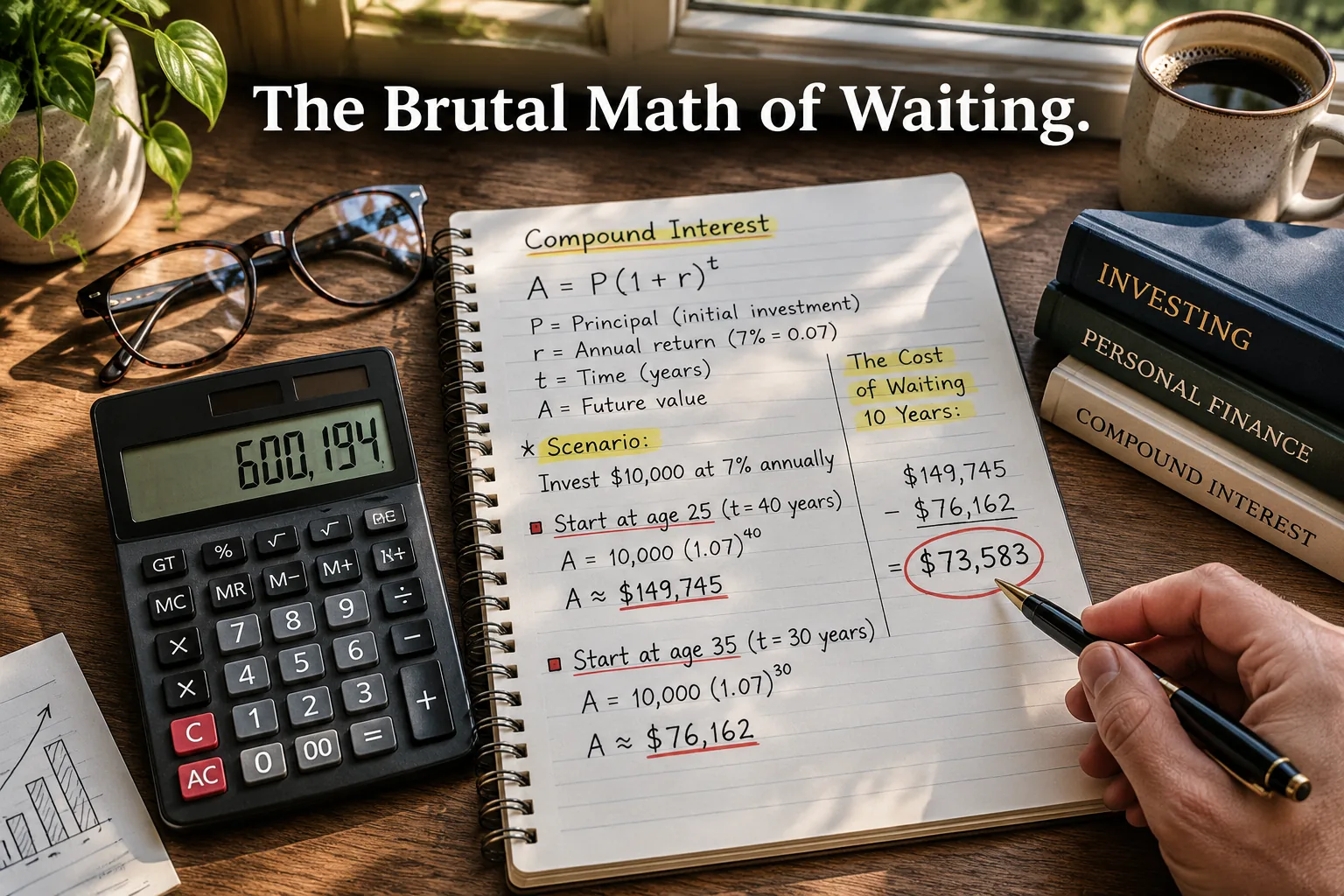
Brutal Math: Two People, Same Monthly Investment
Meet two hypothetical investors.
Person A: The Early Starter
- Starts investing at age 25.
- Invests $300 every month until age 35.
- Stops making contributions at age 35.
- Leaves the accumulated money invested until age 65.
Person B: The Late Starter
- Starts investing at age 35.
- Invests $300 every month until age 65.
- Continues contributing for 30 years.
Both investors earn an assumed 8% nominal annual return, compounded monthly.
For this illustration, contributions are deposited at the end of each month, and investment returns remain constant. Taxes, fees, and inflation are excluded.
Here’s the surprising part:
| Details | Person A | Person B |
|---|---|---|
| Starting age | 25 | 35 |
| Final age | 65 | 65 |
| Monthly investment | $300 | $300 |
| Contribution period | 10 years | 30 years |
| Total personal contributions | $36,000 | $108,000 |
| Estimated final balance | $600,194.51 | $447,107.83 |
Person A contributes only $36,000, while Person B contributes $108,000.
Yet Person A ends up with approximately $153,087 more at age 65.
Why?
Because Person A gives the investment an additional 10 years to grow without needing to contribute another dollar.
The money accumulated during those first 10 years continues compounding for another three decades.
What If You Start Late?
Don’t misunderstand this example.
If you’re already 35, 45, or 55, it doesn’t mean you’ve missed your opportunity.
Starting early is an advantage, not a requirement for building wealth.
If you’re still in your 20s, our guide to saving for retirement in your 20s walks through how to start even on a small salary.
You can still improve your retirement outlook by:
- Increasing your monthly contributions.
- Taking advantage of employer matching.
- Using available catch-up contributions.
- Reducing unnecessary expenses — see our 15 budgeting tips.
- Avoiding high investment fees.
- Working a few additional years if necessary.
The lesson isn’t that everyone must start at 25.
It’s that waiting another five or ten years can make retirement considerably more expensive.
Step 1: Take the Free Money (401(k) Match)

Quick answer
If your employer offers a 401(k) match, contribute at least enough to receive the full available match whenever your financial circumstances allow. Depending on the matching formula, this can represent an immediate 50% or 100% return on the matched portion of your contribution.
A 401(k) is an employer-sponsored retirement savings plan that allows eligible employees to invest part of their salary for retirement.
It’s one of the most useful tools available to American workers.
How Does a 401(k) Match Work?
Suppose your employer offers a dollar-for-dollar match on the first 5% of your salary that you contribute.
Your annual salary is $60,000.
You contribute 5%:
$60,000 × 5% = $3,000.
Your employer contributes another $3,000.
Your retirement account receives:
$3,000 + $3,000 = $6,000.
You personally contributed $3,000, but your employer added another $3,000.
That’s a 100% matching contribution on the eligible amount you invested, before considering market gains or losses.
Not every employer offers the same arrangement.
Some match 50 cents for every dollar you contribute, while others match dollar-for-dollar up to a specified percentage of your salary.
Always read your plan’s matching formula.
What Is Vesting in a 401(k)?
There’s another important detail: vesting.
Vesting determines when employer contributions legally become yours to keep.
Your own salary contributions are always 100% vested. However, employer matching contributions may follow a vesting schedule.
For example, an employer might use:
- Cliff vesting: You become fully vested after a specified period of service.
- Graded vesting: You gradually earn ownership of employer contributions over several years.
Under common federal vesting schedules for traditional 401(k) matching contributions, cliff vesting can reach 100% after three years, while graded vesting can reach 100% after six years.
Certain plans have different rules, including safe harbor and SIMPLE arrangements.
If you leave your employer before becoming fully vested, you may lose some unvested employer contributions.
Source: U.S. Department of Labor, Employee Benefits Security Administration; IRS – Vesting schedules for matching contributions.
2026 401(k) Contribution Limits
For the 2026 tax year, the IRS allows eligible employees to contribute up to:
| Contribution Category | 2026 Limit |
|---|---|
| Standard 401(k) employee contribution | $24,500 |
| Additional catch-up (age 50+) | $8,000 |
| Higher catch-up (ages 60–63) | $11,250 |
This means eligible employees aged 50 or older can generally contribute up to $32,500, while eligible employees aged 60–63 can generally contribute up to $35,750.
These limits are subject to plan provisions and applicable IRS rules.
Employer matching contributions are separate from the employee elective deferral limit, although overall plan contribution limits also apply.
Source: IRS – 401(k) Contribution Limits; IRS, IR-2025-111.
Step 2: Open an IRA (Roth vs. Traditional)
Quick answer
Choose a Roth IRA if paying taxes now makes sense for your expected future tax situation; consider a Traditional IRA if a tax deduction today is more valuable. Your eligibility, income, and retirement tax circumstances all matter.
An Individual Retirement Account (IRA) is another popular way to invest for retirement.
Unlike a 401(k), an IRA is opened individually through an eligible financial institution or brokerage firm.
The two main types are:
- Traditional IRA.
- Roth IRA.
Both offer tax advantages, but they work differently.
Traditional IRA: Get a Potential Tax Break Today
With a Traditional IRA, eligible contributions may be tax-deductible.
This means you could reduce your taxable income for the year in which you contribute.
For example, suppose you earn $70,000 and make a deductible $5,000 Traditional IRA contribution.
Your taxable income may be reduced by $5,000, subject to applicable tax rules.
Your investments can grow tax-deferred inside the account.
However, when you withdraw money during retirement, taxable distributions are generally treated as ordinary income.
Whether you can deduct your contribution depends on your income, filing status, and whether you or your spouse participates in an employer-sponsored retirement plan.
Roth IRA: Pay Taxes Now, Potentially Avoid Them Later
A Roth IRA works differently.
You contribute money after paying income taxes.
You don’t receive an immediate deduction for your contribution.
However, qualified withdrawals in retirement are tax-free, including investment earnings.
For example:
Imagine you contribute $5,000 to a Roth IRA.
Over several decades, your investment grows to $30,000.
If you meet the applicable requirements for a qualified distribution, the entire $30,000 can be withdrawn tax-free.
Generally, qualified Roth IRA distributions require the five-year holding-period condition and an eligible qualifying event, such as reaching age 59½.
Roth IRA vs. Traditional IRA: Which Is Better?
Neither account is automatically better.
A Roth IRA may be attractive if you expect your tax rate to be higher in retirement. A Traditional IRA may make more sense if you expect your tax rate to be lower later or value the deduction today.
| Feature | Traditional IRA | Roth IRA |
|---|---|---|
| Contributions | Earned income; deduction may apply | After-tax money |
| Immediate tax deduction | May be available | Not available |
| Investment growth | Tax-deferred | Tax-free when qualified |
| Retirement withdrawals | Generally taxable | Qualified withdrawals tax-free |
| Income restrictions | Deduction restrictions may apply | Contribution income limits apply |
| Lifetime RMDs for original owner | Generally required | Not required |
2026 IRA Contribution Limits
For 2026, the IRS sets the combined annual contribution limit for Traditional and Roth IRAs at:
| Age | Maximum Annual Contribution |
|---|---|
| Under 50 | $7,500 |
| Age 50 or older | $8,600 |
The additional $1,100 is the IRA catch-up contribution.
These are combined limits, not separate limits for each account. You also generally need sufficient taxable compensation to contribute.
Roth IRA contributions are subject to income phase-outs.
For 2026:
- Single filers and heads of household: phase-out begins at $153,000 and ends at $168,000.
- Married couples filing jointly: phase-out begins at $242,000 and ends at $252,000.
Traditional IRA deduction eligibility also has income-based restrictions when you or your spouse participates in a workplace retirement plan.
Always check the current IRS rules before contributing.
Sources: IRS – IRA Contribution Limits and IRS – Roth IRA Rules; IRS, IR-2025-111.
Step 3: Choose Your Investments (Index Funds vs. Advisors)
Quick answer
For many beginners, a low-cost diversified index fund or target-date retirement fund offers a straightforward way to invest. A retirement financial advisor can provide additional help when your financial situation, tax planning, or retirement goals become more complicated.
Opening a retirement account doesn’t automatically mean your money is invested.
This is a mistake many beginners make.
They open a 401(k) or IRA, deposit money, and assume everything is taken care of.
But the money needs to be allocated to actual investments.
Your available options may include:
- Individual stocks.
- Bond funds.
- Mutual funds.
- Exchange-traded funds (ETFs).
- Index funds.
- Target-date retirement funds.
Option 1: S&P 500 Index Funds
An S&P 500 index fund attempts to track the performance of the S&P 500.
The index represents approximately 500 leading publicly traded US companies.
Rather than purchasing individual shares in each company, you invest in a fund that provides exposure to the underlying index.
Potential advantages include:
- Broad exposure to large US companies.
- Relatively simple portfolio management.
- Generally low costs for many index funds.
- No need to select individual stocks.
However, an S&P 500 fund isn’t a complete retirement strategy by itself.
It concentrates on large US companies and doesn’t automatically provide exposure to international stocks, bonds, or other asset classes.
Your overall allocation should reflect your investment horizon and risk tolerance.
Option 2: Target-Date Retirement Funds
A target-date fund is designed around the year you expect to retire.
For example, if you expect to retire around 2060, you might research a fund with a 2060 target date.
These funds typically:
- Invest in multiple underlying funds.
- Hold a combination of stocks and bonds.
- Automatically rebalance.
- Gradually change their investment allocation as retirement approaches.
This can be useful if you don’t want to manage several investments yourself.
But don’t select a fund based only on its target year.
Compare its investment strategy, risk level, glide path, and expense ratio. Two funds with the same retirement year can have very different allocations and fees.
The SEC specifically advises investors to examine these differences before investing.
Source: SEC Investor.gov – Target-Date Funds.
Option 3: Hire a Retirement Financial Advisor
A retirement financial advisor can help with:
- Retirement income planning.
- Investment allocation.
- Tax-efficient withdrawals.
- Social Security claiming strategies.
- Estate and beneficiary planning.
- Managing multiple retirement accounts.
But professional advice comes at a cost.
Some advisors charge a percentage of assets under management, while others charge hourly fees, fixed planning fees, or commissions.
There isn’t a universal $100,000 portfolio threshold at which hiring an advisor becomes worthwhile.
If you have a straightforward financial situation and a relatively small portfolio, a low-cost target-date fund may be enough to get started.
If your finances involve multiple income sources, business ownership, inheritance, complex taxes, or an early retirement goal, professional advice may be valuable even with a smaller portfolio.
Before hiring someone:
- Understand how they’re compensated.
- Ask whether they act as a fiduciary for the services they provide.
- Review their professional qualifications.
- Ask about conflicts of interest.
- Compare total fees.
- Check their background using FINRA BrokerCheck and the SEC investment adviser resources.
Official resource: FINRA BrokerCheck.
For a deeper explanation of investment products, compounding, and investment costs, read our beginner guide to starting investing.
How to Invest for Retirement at Age 50 (Catch-Up Contributions)

Quick answer
If you’re age 50 or older, the IRS generally allows additional catch-up contributions to eligible 401(k) plans and IRAs, giving you more room to build retirement savings.
Reaching 50 doesn’t mean you’ve missed your chance to retire comfortably.
It does mean you should take a closer look at your retirement numbers.
At this stage, you may have fewer working years remaining, but you can still make meaningful progress through increased contributions and sensible investment decisions.
Take Advantage of Catch-Up Contributions
The 2026 contribution limits provide additional opportunities for older investors.
| Retirement Account | Standard Limit | Age 50+ Limit |
|---|---|---|
| 401(k) | $24,500 | $32,500 |
| Traditional/Roth IRA combined | $7,500 | $8,600 |
Employees aged 60–63 who qualify for the special higher 401(k) catch-up limit can contribute up to $35,750 in 2026 (IRS catch-up contribution rules).
If you haven’t been maximizing your retirement accounts, these additional limits may help you accelerate your savings.
Review Your Current Retirement Gap
Start by checking:
- Your current 401(k) and IRA balances.
- Your expected retirement age.
- Your estimated Social Security benefits.
- Your expected monthly retirement expenses.
- Your outstanding debts.
- Your expected healthcare costs.
Then calculate how much you need to contribute each month to reach your target.
If high-interest debt is competing with your contributions, our guide to paying off debt in 2026 can help you compare payoff methods.
If your current savings are behind, consider increasing contributions gradually whenever your income rises.
Don’t Take More Investment Risk Than You Can Handle
At 50, you may still have 10–15 years or more before retirement.
That can be enough time for a diversified portfolio to experience market fluctuations and potentially recover from downturns.
However, the right investment mix depends on your retirement date, financial resources, risk tolerance, and ability to withstand losses.
Avoid putting all your money into high-risk stocks simply because you’re trying to catch up.
A diversified combination of stocks and bonds may provide a more balanced approach.
How to Invest for Retirement at Age 60 (Shifting to Safety)
Quick answer
At age 60, your retirement strategy should give greater attention to capital preservation, income needs, and withdrawal risk while maintaining enough growth potential to support a potentially long retirement.
This is an important transition.
When you’re 30, a market downturn may be uncomfortable, but you generally have decades to recover.
When you’re approaching retirement, a major loss can have a much greater impact, especially if you need to withdraw money while the market is falling.
This is known as sequence-of-returns risk.
Reconsider Your Investment Allocation
Your portfolio may need a different balance as retirement approaches.
For example, you might consider:
- Diversified stock funds for long-term growth.
- High-quality bond funds for income and diversification.
- Treasury securities for specific savings needs.
- Cash or money market holdings for near-term expenses.
There isn’t one stock-to-bond ratio that’s right for everyone.
Some people retire at 60 with a pension and substantial savings. Others depend heavily on their investment portfolios and Social Security.
Your allocation should reflect those differences.
Also, don’t automatically move everything into cash or bonds at age 60. Retirement can last 25–30 years or longer, and inflation can steadily reduce the purchasing power of money.
Understand the Important Retirement Ages
Many Americans confuse the age for withdrawing retirement savings with the age for receiving Social Security.
They’re separate rules.
Here’s the distinction:
| Age | What It Means |
|---|---|
| 59½ | Generally the age when the 10% additional early-withdrawal tax no longer applies to most taxable distributions from IRAs and qualified retirement plans. |
| 62 | Earliest age most eligible individuals can claim Social Security retirement benefits. |
| 65 | General Medicare eligibility age. |
| 67 | Full Social Security retirement age for people born in 1960 or later. |
| 70 | Age when delayed retirement credits stop increasing Social Security retirement benefits. |
Age 59½: Retirement Account Withdrawals
You can generally withdraw money from traditional IRAs and eligible retirement plans after reaching age 59½ without the 10% additional early-distribution tax.
However, this doesn’t automatically make traditional retirement withdrawals tax-free.
Ordinary income taxes may still apply.
Some retirement accounts and plan distributions also have specific rules and exceptions.
Source: IRS – Exceptions to Tax on Early Distributions.
Age 62: Early Social Security
You can generally begin claiming Social Security retirement benefits at age 62 if you meet the eligibility requirements.
However, claiming early permanently reduces your monthly benefit compared with waiting until full retirement age.
For someone born in 1960 or later, claiming at 62 can reduce the retirement benefit by as much as 30% compared with claiming at age 67.
Age 67: Full Retirement Age
For people born in 1960 or later, the Social Security full retirement age is 67.
At this age, eligible individuals can receive 100% of their calculated full retirement benefit.
Your actual benefit depends on your earnings history.
Age 70: Delayed Retirement Credits
Waiting beyond full retirement age can increase your monthly Social Security benefit.
For individuals born in 1960 or later, waiting until age 70 increases the benefit to 124% of the full retirement-age amount.
There are no additional delayed retirement credits after age 70.
These decisions depend on your health, expected longevity, financial needs, and other retirement income.
Sources: Social Security Administration – Retirement Age and SSA – Delayed Retirement; Medicare eligibility: Medicare.gov.
Plan Your Retirement Withdrawals Before You Stop Working
One of the biggest mistakes people make is focusing entirely on accumulating money without planning how they’ll use it.
Before retiring, consider:
- Which account you’ll withdraw from first.
- How much income you’ll need each month.
- Whether you’ll have Social Security or pension income.
- How your withdrawals will be taxed.
- How much cash you’ll keep available.
- How your portfolio will handle a market downturn.
Use our retirement calculator to test different withdrawal scenarios before making major retirement decisions.
Common Retirement Investing Mistakes to Avoid
Quick answer
The most expensive retirement investing mistakes often involve withdrawing money too early, reacting emotionally to market movements, and ignoring fees that quietly reduce long-term returns.
Even a good investment strategy can fail if you make costly decisions along the way.
Here are three mistakes worth avoiding.
1. Cashing Out Your 401(k) Early
Leaving a job doesn’t mean you should automatically withdraw your 401(k) balance.
Depending on your circumstances, an early taxable distribution may trigger ordinary income taxes and an additional 10% early-distribution tax.
For example, withdrawing $20,000 before age 59½ could mean losing a substantial portion to taxes and penalties if no exception applies.
You may have other options, including:
- Leaving the money in your former employer’s plan, if permitted.
- Rolling it into an eligible new employer plan.
- Rolling it into an IRA.
A properly completed direct rollover can generally help preserve the account’s tax-advantaged status.
Check the receiving account’s fees, investment options, and applicable rollover rules before deciding.
Source: IRS – Exceptions to Tax on Early Distributions.
2. Trying to Time the Stock Market
Trying to predict exactly when the market will rise or fall sounds attractive.
In practice, it’s extremely difficult.
Investors who panic during downturns may sell at depressed prices and miss a subsequent recovery.
A consistent investment schedule can help reduce the temptation to make emotional decisions.
This doesn’t mean you should ignore your portfolio. It means you should review your financial plan rather than constantly reacting to headlines.
3. Ignoring Investment Fees
A small annual expense ratio can have a meaningful effect over several decades.
For example, a 1% annual fee reduces the amount of money available to compound.
Before investing, check:
- Fund expense ratios.
- Advisory fees.
- Account maintenance charges.
- Trading costs.
- Other plan expenses.
For a more detailed explanation of the mathematics, see our beginner guide to starting investing.
Frequently Asked Questions About Retirement Investing
The best retirement strategy depends on your age, savings, income, tax situation, and desired retirement lifestyle. These answers address three common questions beginners and experienced investors often ask.
1. What Is the Best Way to Invest for Retirement?
For many people, a sensible starting strategy involves contributing enough to receive the full employer 401(k) match, using suitable tax-advantaged retirement accounts, and investing in a diversified portfolio.
Low-cost index funds and target-date funds can make retirement investing easier.
Your investment allocation should reflect your time horizon and risk tolerance.
Review your contributions regularly and avoid taking unnecessary risks to chase higher returns.
2. Can I Retire With $500,000?
Yes, it’s possible to retire with $500,000, but whether that amount is sufficient depends on your expenses, location, other income sources, healthcare needs, and retirement duration.
Using the simplified 4% guideline:
$500,000 × 0.04 = $20,000 annually.
That’s approximately $1,667 per month before taxes.
If you also receive Social Security or pension income, your total retirement income could be higher.
However, $500,000 may not be sufficient for someone with substantial housing, healthcare, or lifestyle expenses.
The best approach is to calculate your expected spending rather than assume a particular portfolio balance will work for everyone.
3. How Should My Portfolio Change as I Get Closer to Retirement?
As retirement approaches, many investors gradually reduce their exposure to high-volatility investments and increase their allocation to bonds and cash equivalents.
The purpose is to manage the risk of major losses shortly before or after retirement.
However, your portfolio still needs to account for inflation and the possibility of living 25–30 years after leaving work.
A diversified portfolio with a suitable mix of stocks, bonds, and cash can help balance growth and stability.
Review your allocation regularly rather than making sudden changes based only on your age or recent market performance.
Final Thoughts: Build Your Retirement Before You Need It
You don’t have to become a stock market expert to prepare for retirement.
Start with a realistic savings target. Take advantage of your employer’s 401(k) match, understand the tax benefits of Traditional and Roth IRAs, and choose investments that match your financial goals.
Automate your contributions, diversify your portfolio, and avoid unnecessary fees.
Most importantly, don’t wait for the perfect time to begin.
The earlier you establish a consistent retirement investing habit, the more time your money has to potentially grow.
Start with your current financial situation, make a plan, and improve it as your income and circumstances change.
Automate it. Diversify it. Leave it invested according to your plan.
Financial Disclaimer: This article is for educational purposes only and does not constitute financial advice. Investing involves risk, including the possible loss of principal. Consult a licensed financial professional or tax advisor before making retirement decisions. Contribution limits and other figures were checked against official IRS, SSA, DOL, SEC, and Medicare sources as of 12 November 2026 (Asia/Karachi). Read our full financial disclaimer and editorial policy.
Sources
- IRS, IR-2025-111 – 401(k) limit increases to $24,500 for 2026, IRA limit increases to $7,500
- IRS – 401(k) and profit-sharing plan contribution limits
- IRS – Catch-up contributions
- IRS – IRA contribution limits
- IRS – Roth IRAs
- IRS – Vesting schedules for matching contributions
- IRS – Exceptions to tax on early distributions
- U.S. Department of Labor, EBSA – What You Should Know About Your Retirement Plan
- SSA – Retirement age and benefit reduction
- SSA – Delayed retirement credits (born 1960 or later)
- Medicare.gov – Get started with Medicare
- SEC Investor.gov – Target-Date Funds
- FINRA BrokerCheck
- SEC Investment Adviser Public Disclosure

Syed Hamza Hasnain
Syed Hamza is the Founder of MoneyPulsar. He researches US and Pakistani regulatory frameworks to provide plain-English financial education. About MoneyPulsar →